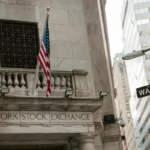
US stocks witnessed a notable uptick on Tuesday as reports emerged that President Trump expressed a readiness to consider ending the ongoing conflict in Iran without fully reopening the crucial Strait of Hormuz. In comments made to the New York Post, Trump suggested that the war “won’t last much longer,” signaling a potential shift towards de-escalation. This move contributed to a rally in major stock indexes, with the S&P 500 rising by 1.4% and the Dow Jones Industrial Average climbing 1.1%, although both indices eased from even stronger gains seen earlier in the trading session. The tech-heavy Nasdaq Composite outperformed, gaining 1.8%.
In a post on Truth Social, Trump characterized Iran’s military capabilities as “essentially, decimated” and indicated that “the hard part is done,” suggesting an inclination to reduce aggressive military actions in the region. This comes amid a backdrop of erratic communication from Washington regarding the U.S. approach to Iran, with some officials hinting at progress in diplomatic discussions, while Trump also floated the idea of seizing control of Iranian oil resources.
While oil prices saw a slight decrease, they remained firmly over the $100 per barrel threshold due to the ongoing U.S.-Israeli military actions against Iran, which have now entered their fifth week. Brent crude was trading at approximately $108 per barrel, while West Texas Intermediate crude hovered around $104 per barrel.
Consumer sentiment data released by the Conference Board indicated an unexpected rise in confidence, climbing to a reading of 91.8—higher than analysts’ expectations. However, this uptick was tempered by persistent worries among American households regarding future price increases. Meanwhile, the February Job Openings and Labor Turnover Survey (JOLTS) pointed to the weakest hiring rate since 2020, showing that U.S. job openings fell to 4.8 million, down 387,000 year-over-year.
Further illustrating the pressure on consumer sentiment, the national average for gasoline prices surged past $4 per gallon for the first time since August 2022, reflecting the energy market’s tumultuous response to the conflict in Iran. Diesel prices also rose, averaging $5.45 per gallon.
In addition to the broader market movements and economic indicators, specific corporate developments were noteworthy. Marvell Technology’s stock surged 8% in premarket trading following the announcement of a $2 billion investment from Nvidia, aimed at collaboration on AI infrastructure. Meanwhile, Unilever confirmed a significant merger of its food business with spice leader McCormick in a deal valued at $44.8 billion, further consolidating the consumer goods sector.
Despite the optimism reflected in certain stock movements, the persistent rise in fuel costs paints a more complex picture for consumer outlook, especially amid the looming effects of rising inflation expectations discussed by Federal Reserve Chair Jerome Powell. Traders and investors continue to monitor developments closely as they navigate an increasingly volatile market landscape.