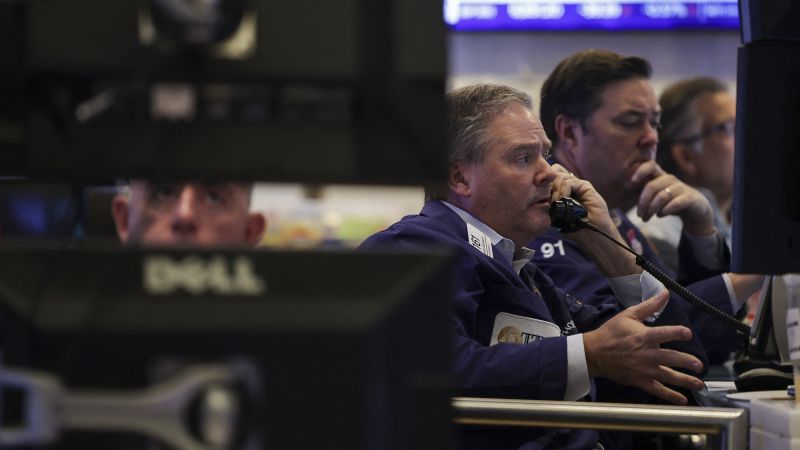
US stocks experienced a significant downturn on Thursday, spurred by increasing worries over high valuations in the technology sector and a prevailing risk-off sentiment in the market. New data revealing a troubled job market contributed to these concerns, amplifying anxiety among investors.
The Dow Jones Industrial Average dropped 507 points, or 1.07%, while the S&P 500 fell by 1.16%. The Nasdaq Composite, heavily weighted with tech stocks, tumbled by 1.84%. A broad range of technology and AI stocks mirrored this decline, reflecting ongoing volatility amid fears of inflated valuations and a potential market bubble.
Key tech stocks saw notable losses, with Advanced Micro Devices (AMD) plummeting 7%, Palantir Technologies (PLTR) down 5.5%, and Nvidia (NVDA) decreasing by 3%. This pattern of decline communicated a disquieting sense of uncertainty lurking beneath the surface of recent market performances.
The VIX, often referred to as Wall Street’s fear gauge, surged by 12%, while CNN’s Fear and Greed index indicated an environment of “extreme fear.” Wealth management analysts pointed to Warren Buffett’s preferred market indicator, which assesses the total value of the US stock market against economic growth. This indicator is currently at a record high, exceeding 200%, suggesting a strong potential overvaluation in the stock market.
Torsten Slok, chief economist at Apollo Global Management, noted the historically extreme valuations of the S&P 500. In addition to market fluctuations, data released indicated a stark increase in announced job cuts in October—the highest for that month since 2003, as reported by Challenger, Gray & Christmas.
In light of these economic signals, investors increasingly turned to government bonds, driving yields down. US Treasury bonds are traditionally seen as secure investments during economic slowdown fears. A deteriorating labor market may bolster arguments for the Federal Reserve to consider interest rate cuts, prompting investors to purchase Treasuries to secure current yields.
Ulrike Hoffmann-Burchardi, global head of equities at UBS Global Wealth Management, expressed confidence in quality fixed income, highlighting its appealing combination of income potential and resilience during economic downturns.
Additional uncertainties loomed over Wall Street this week as the Supreme Court commenced deliberations regarding the legality of President Donald Trump’s extensive global tariff measures, enacted under emergency powers. Although investor focus on tariffs had waned recently due to the revenue generated easing bond concerns related to US deficits, a ruling against the tariffs could complicate the economic landscape once again.
The stock market had enjoyed a strong performance over recent months, with the Dow posting consecutive monthly gains from April to October—its most prolonged winning stretch since late 2017. These increases were fueled by robust corporate earnings and enthusiasm surrounding the AI sector. However, there remains a palpable apprehension that recent stock market successes might be overly reliant on technology firms.
In the cryptocurrency world, Bitcoin fell by 2.4%, hovering around $101,500, indicating a broader risk-off sentiment among investors. The digital currency has seen a stark decline of nearly 20% since reaching an all-time high of over $126,000 just a month ago, further emphasizing current market anxieties.