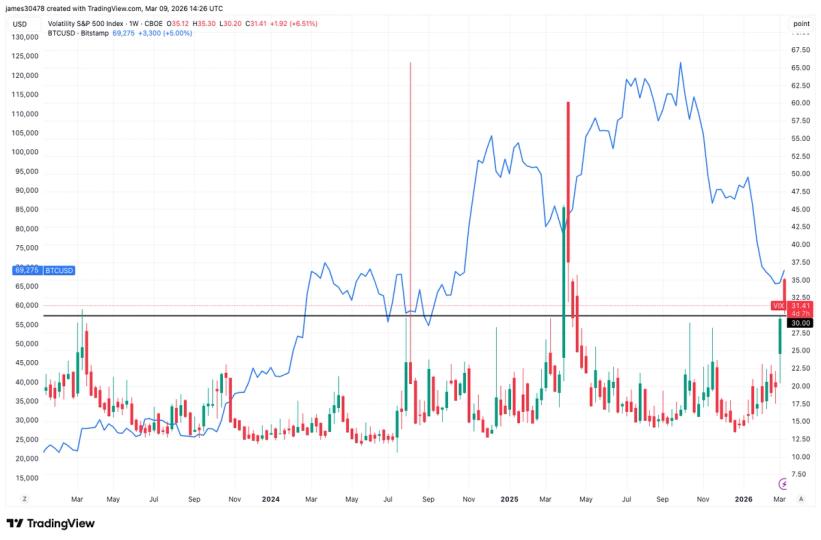
The recent behavior of the VIX and bitcoin has captured the attention of market analysts, demonstrating a notable inverse relationship between the two. The CBOE Volatility Index (VIX), often regarded as Wall Street’s “fear gauge,” has surged past 35 for the first time in nearly a year, a rise that indicates an increase in anxiety among investors as traditional markets react to fluctuating oil prices.
This spike in the VIX is particularly significant as it coincides with a dramatic uptick in crude oil prices. West Texas Intermediate (WTI) crude oil soared to around $120 at the opening of futures markets on Sunday before retracting to around $100. This volatility in oil has exerted downward pressure on traditional safe havens like U.S. stocks and gold, leading to declines in both asset classes.
In stark contrast, bitcoin has displayed resilience during this tumultuous period, climbing approximately 5% over the past day to surpass $69,000. Historically, such spikes in the VIX have often aligned with local bottoms for bitcoin. Notable instances include April 2025, when bitcoin found support around $75,000 as the VIX soared to about 60, and August 2024, when the unwinding of the yen carry trade pushed the VIX above 64, causing bitcoin to drop to approximately $49,000. A similar trend was observed during the Silicon Valley Bank crisis in March 2023, where a rise in the VIX above 30 corresponded with bitcoin hitting a local low of roughly $20,000.
Adding another layer to the analysis, the Bitcoin Volmex Implied Volatility Index (BVIV) has shown indications that the crypto market has already navigated its panic phase. The BVIV, which derives its values from bitcoin options pricing, peaked above 96 in early February when bitcoin dipped to around $60,000. Currently, the index is hovering just above 60. This divergence suggests that the crypto markets may have preempted the stress impacting conventional financial systems.
Despite this relative strength in bitcoin, a VIX approaching 30 hints that volatility in traditional markets may still have room to escalate. Investors are watching closely as the interplay between these two indicators could provide critical insights into future market movements and investor sentiment across both crypto and traditional finance sectors.