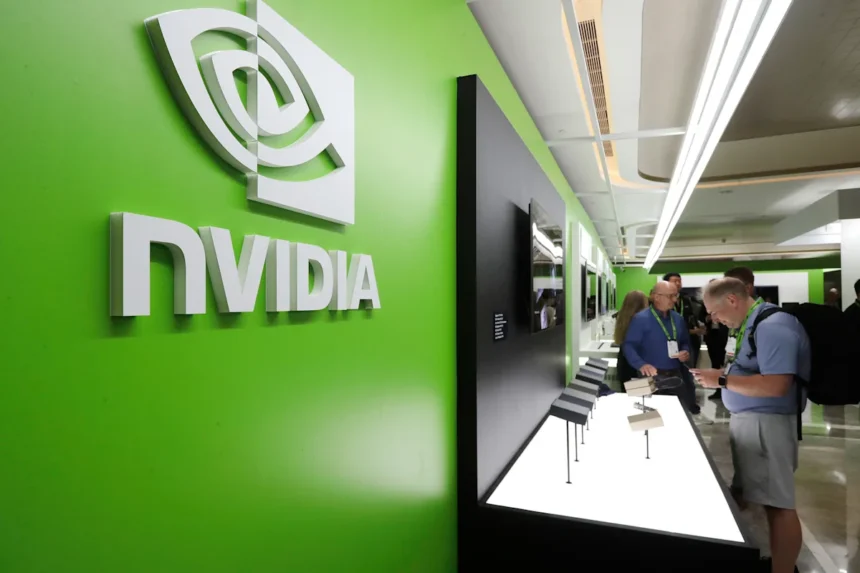
Wall Street had high hopes that Nvidia Corp.’s impressive earnings would ease growing concerns about the potential bubble in artificial intelligence (AI) stocks. However, those expectations did not materialize. The current landscape of AI investments presents a complex situation that varies dramatically based on individual perspectives.
Skeptics of the AI trade express unease about inflated market valuations resulting from an increasing number of investors pursuing a limited selection of growth stocks linked to the AI surge. They argue that the substantial amounts—hundreds of billions of dollars—being spent by these firms to remain competitive are unsustainable, particularly as they begin to incur debt. Moreover, the interdependent nature of these financing arrangements raises the risk of systemic collapse; if one company falters, it could trigger a chain reaction affecting the entire sector.
Conversely, optimistic investors view the recent downturn in AI stocks as a healthy correction within a larger growth trajectory. For them, the leading tech companies, including Microsoft, Amazon, Meta Platforms, and Alphabet, are deemed likely to continue their substantial investments in AI development without signs of retreat. Bolstered by strong market demand and a regulatory environment perceived as favorable for growth, this group sees the current investment cycle as merely at its inception.
“There is certainly a division,” noted Dec Mullarkey from SLC Management. He highlighted the length of the current bull market and the stretched valuations, leading to heightened fears of an AI-related collapse. Yet another faction of investors remains hopeful about potential stimulative measures such as anticipated Federal Reserve rate cuts, reduced regulations, and increased mergers and acquisitions.
The uncertainty surrounding these differing views was starkly illustrated in the stock market’s volatile response to Nvidia’s earnings report. Initially, Nvidia’s stock surged over 5%, buoying other AI-related shares before reversing, ultimately closing down 3.2%. Major indices like the S&P 500 and Nasdaq 100 displayed similar patterns, spiking only to retreat and end the day with losses.
Analysts have pointed out that while Nvidia’s strong earnings temporarily lifted spirits, broader concerns about operational factors such as energy demands, profit margins, and return on investment (ROI) remain unresolved. These questions are critical for sustaining any relief rallies.
Despite some relief emerging on Friday, as major equity indices exhibited both gains and losses before concluding positively, there remains a palpable anxiety in the market. Investors are starting to worry about signs of a potential bubble, driven by elevated valuations and complex financing arrangements among AI-related firms.
Nvidia’s latest results were largely anticipated given the planned spending of its key customers—Microsoft, Amazon, Meta, and Alphabet—who together account for more than 40% of Nvidia’s sales. These companies are projected to increase their capital expenditures by 34% to $440 billion over the next year.
However, the worries extend beyond Nvidia to a broader segment of the semiconductor industry, where an index tracking chip stocks has dropped 11% in November, marking its worst monthly performance since 2022. Notably, Advanced Micro Devices and Arm Holdings, among others, have seen significant declines.
Investors are now questioning when significant cash inflow from these AI investments will yield meaningful growth and profitability. There is a consensus on Wall Street that a clearer picture of ROI needs to emerge for the AI sector to regain momentum.
While Nvidia’s strong earnings helped alleviate immediate fears, they did little to suppress anxieties about larger players’ spending habits. For instance, Meta’s shares fell 21% following its earnings report, and Microsoft experienced a 13% decline, reflecting investor concerns over aggressive capital expenditures. Companies perceived to have weaker financial positions, like CoreWeave and Oracle, faced even steeper declines, with CoreWeave’s stock plummeting 46% and Oracle’s dropping 24%.
The investment environment surrounding AI remains fraught with tension and uncertainty. Investors find themselves divided, with stark contrasts in optimism and skepticism influencing market sentiment. As discussions about macroeconomic factors, the pace of AI progress, and the volatility of the cryptocurrency market persist, it appears that the journey in AI investment is bound to become increasingly turbulent.