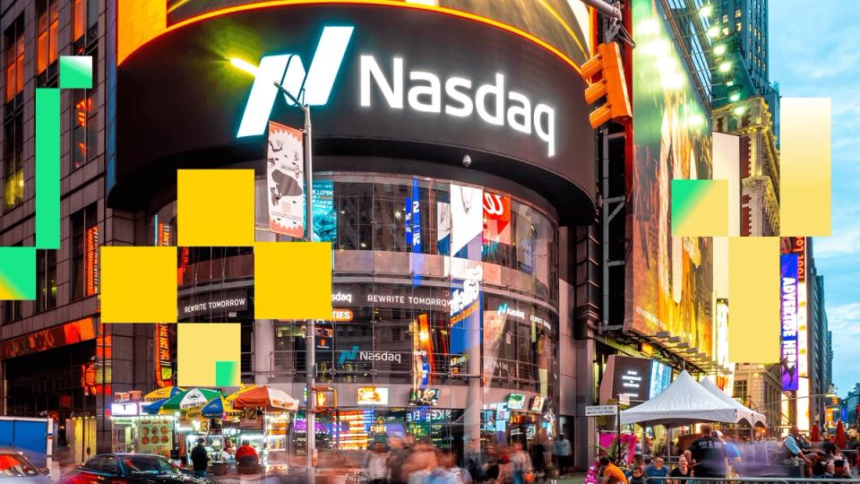
In a significant move towards integrating digital assets with traditional finance, Wall Street’s leading exchanges are working to incorporate the $126 trillion equity market onto blockchain technology. This ambitious initiative is rooted in partnerships with established crypto exchanges, signaling a collaborative approach to innovation in financial markets.
Notable developments over the past week include Nasdaq and the Intercontinental Exchange (ICE), the operator of the New York Stock Exchange, both forming alliances with crypto platforms to explore tokenization. Nasdaq’s strategy focuses on creating a framework that would enable publicly listed companies to issue shares in blockchain-based formats, all while maintaining established ownership rights and governance structures. To facilitate the global distribution of these tokenized equities, Nasdaq is partnering with Payward, the parent company of the cryptocurrency exchange Kraken. This initiative could see its market debut as early as the first half of 2027.
In a separate but related effort, ICE announced a strategic investment in the crypto exchange OKX, valued at an impressive $25 billion. This partnership aims to introduce new offerings that include tokenized stocks as well as crypto futures, effectively leveraging OKX’s vast user base of 120 million.
These partnerships underscore a broader transformation in the financial sector, where traditional trading practices are poised for disruption. For decades, various asset classes such as stocks, bonds, and funds have operated on separate trading systems governed by limited hours. However, blockchain technology offers the potential for a unified, continuous marketplace—a vision championed by industry leaders as the “everything exchange.” Antoine Scalia, the founder and CEO of the crypto accounting platform Cryptio, emphasized that this represents a crucial shift in how asset trading will evolve, indicating a merging of traditional finance with the burgeoning world of cryptocurrencies.
The recent developments align with a January statement from the SEC that clarified the legal status of tokenized securities, acknowledging that they carry the same weight as conventional equities. This regulatory clarity allows established financial institutions to engage in the trading of tokenized equities with confidence.
As traditional exchanges like Nasdaq seek to tap into the crypto trading demographic, and cryptocurrency platforms seek the legitimacy and outreach provided by established market players, a unique “frenemy” dynamic is emerging. Scalia noted that while these entities might be seen as competitors, their interdependence fosters a relationship that could reshape the landscape of financial trading.
While tokenized equities currently represent only a small fraction—approximately $1 billion—of the global equities market, projections suggest a substantial upside. According to a joint study by Boston Consulting Group and Ripple, the market for tokenized assets could expand at a staggering rate of 53% annually, potentially reaching $18.9 trillion by 2033. The growth rate for tokenized stocks has already seen substantial increases, having tripled since mid-2025.
The advantages of tokenizing equities extend beyond mere market expansion; they promise continuous price discovery and the capability for around-the-clock trading. Yuki Yuminaga, the founder of tokenization startup Tenbin Labs, noted that the transition to blockchain could lead to improved liquidity and reduced market volatility. Additionally, tokenized shares could facilitate more efficient lending and borrowing through the decentralized finance (DeFi) space, enhancing capital efficiency by allowing these shares to be used as collateral in lending markets.
With notable players like Nasdaq and the New York Stock Exchange entering the tokenization landscape, the integration of traditional equities and blockchain technology could address liquidity challenges currently faced by tokenized markets. By creating connections between traditional and on-chain liquidity pools, these exchanges may be on the brink of redefining how assets are traded in the modern financial ecosystem.