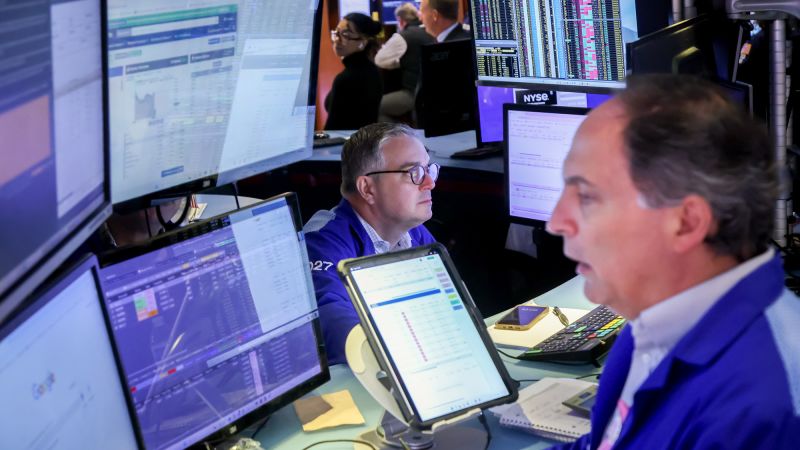
In a dramatic turn of events, Wall Street has faced significant challenges as the month of November unfolds, marking a stark contrast to the steady gains investors had enjoyed in previous months. The tech-heavy Nasdaq Composite has seen a notable decline of over 3.5% so far this month, poised for its first losing month since March. In a matter of just two weeks, the Nasdaq has lost nearly $2 trillion in market value, leading to a widespread sell-off of tech stocks.
Friday morning’s stock futures indicated further declines, with Nasdaq 100 futures down 1.4%, S&P 500 futures falling by 0.9%, and Dow futures decreasing by 283 points, or about 0.6%. The benchmark S&P 500 index has experienced a drop of more than 1.5% in November, while the Dow has also moved slightly into negative territory. In just over two weeks, the S&P 500 has seen a loss of approximately $1.3 trillion in market value, retreating from a record high reached in late October.
Investors, having had high hopes after months of market gains, are becoming increasingly cautious and easily disappointed. The prevailing sentiment has been exacerbated by the recent government shutdown, which halted the release of key economic data. With this data now resuming, there is uncertainty about the health of the world’s largest economy. This uncertainty is making investors apprehensive regarding the Federal Reserve’s potential decisions on interest rates in December, causing additional jitters across Wall Street.
Ed Yardeni, president of Yardeni Research, commented on the situation, noting that the earlier lack of data allowed for more optimistic speculation. Now, he emphasizes the need for a data-dependent approach, which could bring less favorable news. Market enthusiasm, particularly driven by artificial intelligence advancements, has started to wane as some investors reassess the sustainability of tech stock returns amid rising valuations.
In a sign of the risk appetite’s retreat, Bitcoin, often a barometer for investor sentiment, fell 5% on Friday to around $95,000. The cryptocurrency has plummeted nearly 25% since reaching a record high in early October.
As Wall Street awaits a surge of delayed economic data, the prevailing anxiety about the Federal Reserve’s next steps is evident. Traders currently estimate a 53% chance of an interest rate cut in December, a noticeable decline from a 96% chance just a month earlier. At the last policy meeting, Fed Chair Jerome Powell suggested uncertainty surrounding further rate cuts, while remarks from other Fed officials have highlighted hesitance to decrease rates further.
Though some analysts, like those from Evercore ISI, still predict a rate cut next month, they acknowledge the difficulty in predicting outcomes due to “data blindness.” The previous rate cuts in September and October had bolstered stocks, but a pause in such cuts may hinder the momentum of equities that have thrived on the expectation of lowered borrowing costs, particularly within AI and tech sectors that have led the market rally.
On a broader level, the sentiment driving markets on Friday was characterized by “extreme fear,” according to CNN’s Fear and Greed index. However, not all investors view the current pullback negatively; some argue it represents a healthy reassessment of stock values after an extended period of gains. Investors who have seen consistent growth from April through October now appear to be recalibrating their expectations, sparked by mounting skepticism surrounding the profitability of major tech investments.
Concerns are intensifying regarding the financial viability of significant spending by big tech companies in the AI sector. Keith Lerner, chief market strategist at Truist, pointed out that the technology sector has been under selling pressure recently due to rising debt and capital expenditures, leading investors to question whether these expenses will result in future profits.
For instance, Oracle shares spiked by 36% in a single day back in September following a massive $300 billion deal with OpenAI, yet those gains have evaporated in the days since. Similarly, other companies involved in substantial AI deals are experiencing skepticism regarding their financial outcomes.
Meta has seen a decline of 23% since reaching a peak in mid-August, while Nvidia shares have dropped 12% since hitting their high in late October. Palantir shares have also fallen 17% since a recent peak on November 3.
Garrett Melson, a portfolio strategist at Natixis Investment Managers Solutions, noted this month has featured a significant rotation out of tech stocks into other sectors. He characterized the pullback as investors’ protective response to avoid losing profits after a robust market recovery since April.