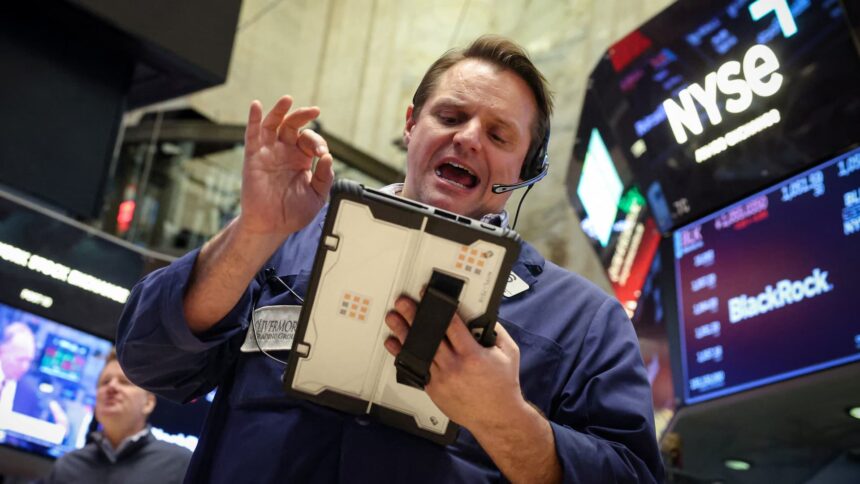
Traders on Wall Street are adopting a “could’ve been worse” mentality as they navigate through a tumultuous period marked by significant fluctuations within various sectors. Despite these upheavals, the majority of stocks have managed to perform relatively well, resulting in a stable week for the S&P 500, which closed at levels not seen in over 112 days. This level is reminiscent of a time in late October when optimism was fueled by expectations of an economic revival, Federal Reserve rate cuts, and a burgeoning AI investment boom.
Now, however, the market is rife with challenging questions as investors grapple with issues that demand clarity. One such question revolves around whether the current downturn in established businesses reflects greater potential risks than the benefits promised by the ongoing AI expansion. The recent sharp declines in sectors such as software, data services, and logistics raise concerns about the sustainability of growth for companies heavily invested in these areas.
Another point of contention lies in the performance of Nvidia’s shares, which appear stagnant despite projections of significant AI capital expenditure growth over the next few years. Investors are left wondering why the tech giant’s forward price-to-earnings ratio is retracting to its lowest premium since 2015, posing questions about the perceived value of such high-growth tech stocks.
Consumer-exposed stocks, traditionally viewed as cyclical, are underperforming against defensive staples, prompting speculation about whether this could signify a deep-rooted concern or merely a temporary lull in market appetite. Similarly, sustained stock price declines for major financial institutions such as JPMorgan and Goldman Sachs, despite positive market narratives around deregulation and capital trends, add layers of complexity to investor sentiment.
Amid this backdrop, there are some reassuring signs: the S&P 500 has shown resilience, finding support amidst various sell-offs, and the equal-weighted S&P 500 is outpacing its market-cap-weighted counterpart. This divergence suggests a broader market strength that belies the turbulence experienced in certain sectors.
Market analysts, including John Kolovos from Macro Risk Advisors, emphasize the unusually flat performance of the index in light of significant declines in standout stocks like Netflix and Microsoft. The current environment features a notable shift in market dynamics, moving away from growth-focused narratives.
In terms of macroeconomic conditions, recent job and inflation data did not lean toward a stagflation scenario, as many feared. Instead, these reports boosted confidence, reinforcing a narrative of a potential soft landing for the economy. Global markets seem poised to account for a re-inflated growth outlook, albeit amid cautious optimism regarding corporate earnings.
In essence, while many sectors are grappling with uncertainty and declining valuations, there remains a broader market narrative that reflects underlying strength and adaptability. The shift from intangible growth stocks to more traditional, asset-heavy investments highlights an evolving risk-reward landscape in the wake of dizzying AI investments.
Additionally, with the major tech firms collectively gearing up for substantial AI capital expenditures, the implications for the corporate landscape are significant. The migration from virtual assets to more tangible values is taking place as investors reassess their strategies in light of these emerging trends.
Despite the risks involved, market participants remain aware of the potential for a shift back to the high-growth tech stocks that initially drove market enthusiasm. The preparatory movements in anticipation of substantial IPOs from high-profile tech firms suggest that the market is bracing for a new phase, balancing cautious optimism with the realities of shifting investor sentiment.