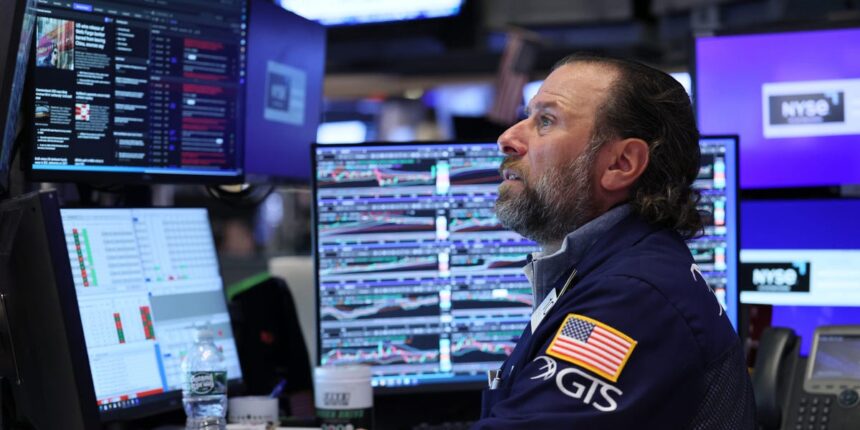
Wall Street economists and investors appear largely optimistic about the U.S. economy’s prospects for sidestepping a recession in the near future. This comes despite recent signals indicating a weakening labor market, characterized by a notable decline in payroll growth. Over the past four months, the U.S. has averaged fewer than 100,000 new jobs per month, a trend often associated with recessionary periods. Adding to this concern, the Bureau of Labor Statistics recently revealed that it had overestimated job creation by 911,000 over the past year.
Albert Edwards, the chief strategist at Société Générale and known for his pessimistic views, has voiced serious concerns regarding the current economic situation. In a recent communication to clients, he presented several troubling charts that indicate a potential impending recession. One of the notable models he referenced is from Moody’s, whose chief economist, Mark Zandi, has stated that the likelihood of a recession is “uncomfortably high.” As of August, Zandi’s model assigned a 48% probability to a recession occurring, a threshold that historically signals imminent economic downturns once it surpasses 50%.
Edwards acknowledged his track record in predicting recessions has not been perfect, but emphasized the importance of Zandi’s insights, given Zandi’s typically measured outlook. “A 48% probability seems really pretty darn high to me,” he remarked, highlighting the model’s historical tendency to peak at around 62% even during deep recessions.
Another critical chart discussed by Edwards illustrated the unemployment rate alongside its 36-month moving average. Historically, whenever the unemployment rate exceeds its moving average, a recession has usually followed shortly thereafter. The last significant crossover occurred in May of the previous year, and Edwards pointed out that the onset of recession seems to be lagging compared to past patterns.
Furthermore, Edwards shared findings from the Kansas City Federal Reserve’s Labor Market Conditions Indicator, which has displayed a marked decline over recent years and often correlates with economic downturns. This model evaluates 24 labor-related indicators, such as job availability and wage trends. Interestingly, while these indicators have weakened, stock prices have risen over the past few years, bolstered by increased demand for artificial intelligence technology, benefiting major tech firms that significantly influence the market.
Despite the concerning trends in labor market indicators, some hard data remains resilient. For instance, both initial and continuing unemployment claims remain historically low, suggesting that immediate labor market distress is not yet widespread. In light of these mixed signals, the Federal Reserve cut interest rates for the first time in 2025 during its recent September meeting, attributing the move to a softer job market. The Fed anticipates further rate cuts, with two additional reductions of 25 basis points expected this year to stimulate economic growth and bolster the labor market.