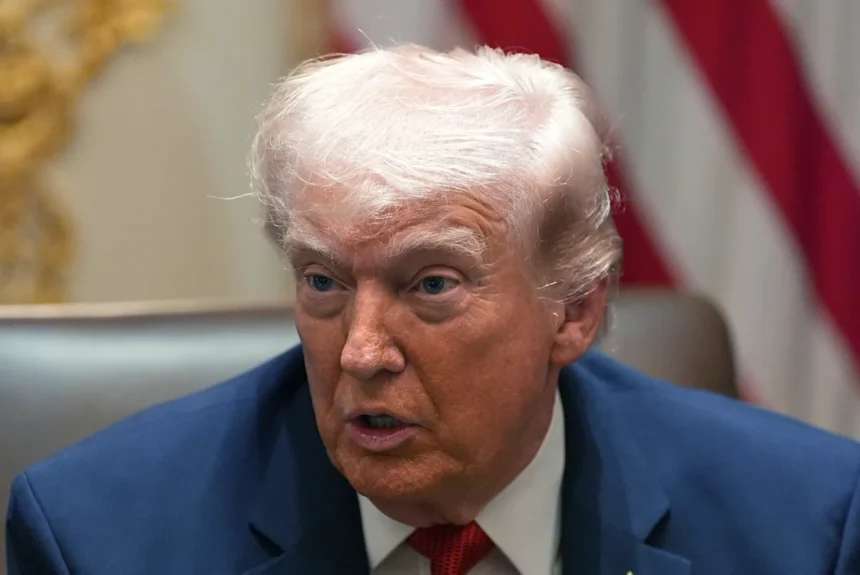
Wall Street is currently observing the emergence of a familiar pattern in the behavior of President Trump, often referred to as the “TACO” playbook—an acronym for “Trump Always Chickens Out.” This terminology resurfaced last week following the president’s decision to postpone military strikes against Iranian energy facilities. Trump’s intention is to create space for negotiations aimed at reopening the critical Strait of Hormuz, a vital passage for the world’s oil supply.
Daniela Hathorn, a senior market analyst at Capital.com, noted that the recent actions resemble a classic TACO dynamic, with Trump signaling potential escalation but then stepping back in light of economic ramifications. Hathorn reflected that this may indicate the U.S. administration’s desire to find an exit strategy from the conflict, even if the path remains unclear.
Nancy Tengler, CEO of Laffer Tengler Investments, remarked that her firm sensed a growing fatigue within the administration regarding the ongoing tensions, particularly in relation to their impact on the financial markets. As a strategic move, her team purchased S&P 500 call options on March 20, anticipating a market rebound. Their predictions proved accurate when Trump announced on March 23 that the planned strikes would be put on hold due to “productive” discussions, a notable reversal from threats made just days earlier. Tengler emphasized Trump’s awareness of the stock market’s importance and his motivation to improve consumer sentiment, particularly as tax refunds could be adversely affected by rising fuel prices.
The TACO playbook is not new to Wall Street, where traders are well-versed in its implications. A previous instance occurred in April when the stock and bond markets experienced sharp declines due to Trump’s announcement of extensive tariffs. However, after pausing the implementation of these tariffs to pursue individual negotiations, the S&P 500 rallied, reaching historic highs by the end of the year.
Recognizing the pattern, analysts have developed tools like BCA Research’s “Trump Pain Point Index,” which forecasts policy shifts based on various economic indicators, including stock market behavior, Treasury yields, mortgage rates, gas prices, inflation expectations, and the president’s popularity. Recently, the index reached significantly high levels, raising questions about whether another TACO maneuver could stabilize market conditions.
However, experts caution that the successful execution of such a strategy hinges on Iran’s responsiveness, which has so far been lacking. Tehran has dismissed a U.S. ceasefire proposal associated with reopening the Strait of Hormuz, while U.S. military resources, including Marines, have been deployed in the region. As of now, oil prices continue to escalate, with Brent crude futures achieving a 40% increase since the outbreak of hostilities.
Recent data shows that while Brent prices exceed $105 per barrel, the broader market has fluctuated, with the S&P 500 seeing a decline of approximately 7%. The Nasdaq and Dow indices have also entered correction territory, each down over 10% from previous highs.
In light of these dynamics, experts are advising investors to exercise caution. Tim Urbanowicz, the chief investment strategist at Innovator Capital Management, highlighted concerns regarding economy-wide inflation and rising interest rates in response to sustained elevated oil prices. He stated, “We don’t see an easy off-ramp here,” emphasizing the complexities ingrained in the current geopolitical landscape.