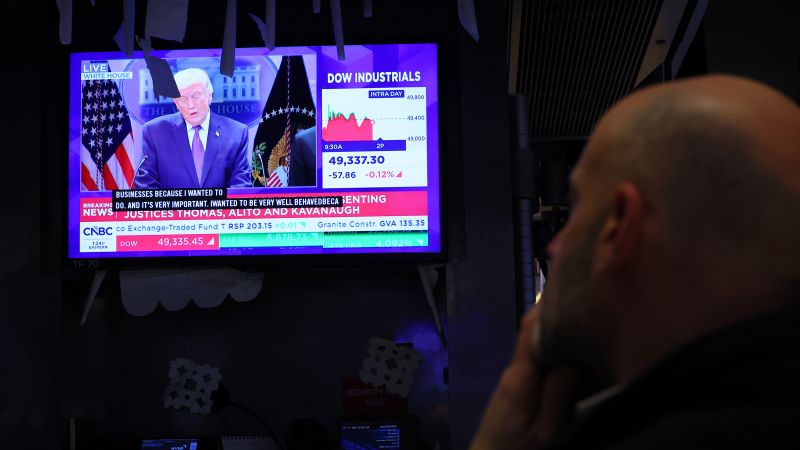
In a surprising turn of events, Wall Street experienced a dramatic shift from negative sentiment to optimism on Monday, following a notable announcement from President Donald Trump regarding tensions with Iran. Over the weekend, Trump set a deadline for Iran to fully reopen the Strait of Hormuz, threatening military action against Iranian power plants if the deadline was not met. However, two hours before the U.S. markets opened, Trump postponed that deadline by five days, citing “VERY GOOD AND PRODUCTIVE CONVERSATIONS” with Tehran aimed at achieving a “COMPLETE AND TOTAL RESOLUTION” of ongoing conflicts.
This change in tone led to a significant surge in U.S. stock futures and a decline in oil prices. The Dow Jones Industrial Average, which had hovered near correction territory, briefly increased by over 1,000 points before settling to a closing gain of 630 points, or 1.4%. The broader S&P 500 and Nasdaq also saw increases of 1.2% and 1.4%, respectively.
Market analysts expressed skepticism about whether traders truly believed in Trump’s promises. Many recalled that just two weeks prior, the President had declared the situation in the Middle East to be “very complete,” which similarly sparked a short-lived rally. Trump’s history of making statements only to later walk them back has led to the development of a trading strategy dubbed the “TACO trade”—an acronym for “Trump always chickens out.”
Despite reservations, analysts acknowledged that traders perceived the President’s latest message as a form of reassurance. Trump’s tendency to respond to poor market performance appeared to reinforce the belief that he might shy away from drastic measures that could further destabilize the market.
“There’s no real fundamental reality to any of this trading — it’s just trading Trump,” noted Daniel Alpert, managing partner of Westwood Capital. This sentiment reflects a prevailing mindset on Wall Street, where the reactions to Trump’s statements often rely more on investor sentiment than factual accuracy. Although Iran denied the talks Trump referenced, many traders operate under the assumption that the perception of news matters more than the veracity of the claims.
Alpert likened the markets to a beauty contest, where traders focus on what they believe other investors will favor, rather than their own judgments of reality. “If you’re trading markets, you’re focused on what other people think,” he explained, emphasizing that market dynamics often operate on the psychology of traders rather than solid evidence.
Supporting this narrative, Steve Sosnick, chief market strategist at Interactive Brokers, pointed out that stock traders have been closely following movements in the oil market, which tends to have a clearer perspective on developments in the Persian Gulf. A significant decrease in oil prices contributed to the stock market rally, suggesting that the sharp contrast in movements signified a more complex trading environment than simple exuberance.
Additionally, the phenomenon of Fear of Missing Out (FOMO) played a key role in amplifying the rally. “Nobody wants to miss a rally,” Sosnick remarked, indicating that even minor positive news can elicit strong reactions from investors eager to capitalize on upward trends.
As traders assimilate both the latest geopolitical developments and market signals, the ongoing uncertainty may continue to impact trading behavior well beyond this initial reaction.