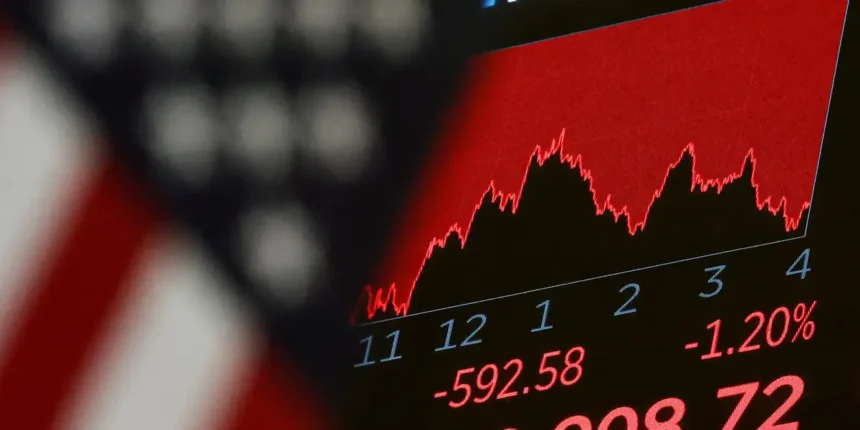
After a turbulent week in financial markets, marked by a substantial sell-off in the software sector that affected tech stocks and the broader market, Wall Street analysts are suggesting strategies for investors to navigate potential future downturns. The Nasdaq Composite index fell by 2% during the week, and the iShares Expanded Tech-Software Sector ETF reported a more significant decline of over 12%. Despite a slight recovery on Friday, experts believe that this week’s downward trend indicates a longer-term shift rather than a temporary blip.
Analysts are pointing towards a rotation away from tech stocks, commonly viewed as high-growth investments, towards what are being termed “old economy” sectors. Piper Sandler’s research indicates that the current market dynamics are favoring cyclical and value sectors, including Energy, Industrials, Materials, Consumer Staples, and Banks. These sectors have performed well, with notable gains in energy and consumer staples as tech stocks falter. Goldman Sachs analysts also highlighted this shift as a movement back to “real economy” industries, suggesting that investors are increasingly seeking stability from the potential disruptions associated with artificial intelligence (AI).
In the face of rising concerns over inflated tech valuations and the sustainability of the AI boom, Bank of America strategists provided insights on creating a hedge against a potential AI bubble. They propose a strategy referred to as “transition” investing, which allows portfolios to benefit indirectly from AI advancements. This involves focusing on sectors like electrification, infrastructure, grid expansion, metals, and defense, which are expected to see growth due to the expanding influence of AI technologies without directly investing in tech firms.
Furthermore, identifying the key beneficiaries in the AI field is crucial for investors looking to capitalize on current market fluctuations. Futurum Group’s CEO Daniel Newman emphasized the importance of differentiating between successful and struggling AI stocks. He outlined criteria for identifying winners, such as those generating returns from AI expenditures, developing proprietary chips, and monetizing AI services. Companies like Amazon, Microsoft, Alphabet, ServiceNow, Palantir, and Tesla were highlighted as potential leads in this sector.
For those who maintain a bullish perspective on technology, Dan Ives of Wedbush recommends a “buy the dip” approach. He views the current decline as an overreaction, referring to it humorously as a “garage sale” for tech stocks. Despite the challenges posed by AI technologies, Ives believes that the downturn’s severity is exaggerated and not reflective of the sector’s true potential. He named five technology stocks that he considers to be strong buying opportunities at current discounted prices: Microsoft, Palantir, Snowflake, Salesforce, and CrowdStrike.
As investors strategize for the next phase of this market cycle, they face a crucial moment to reassess their portfolios in light of these shifts and varying opportunities within and outside the technology sector.