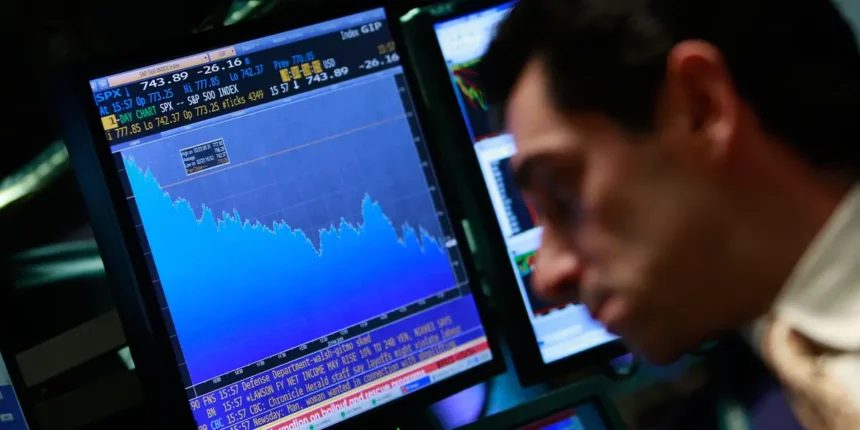
A prominent Wall Street strategist has issued a warning that U.S. stocks may be on the brink of a correction that could exceed the historical sell-off known as “Liberation Day.” Larry McDonald, a seasoned strategist and former Lehman Brothers trader, expressed his concerns in a recent interview, suggesting that multiple risks are combining to create a precarious situation for the stock market. He indicated that the S&P 500 could see declines of 20% to 35% by the first quarter of next year, depending on evolving market conditions.
McDonald emphasized that the current risk-reward scenario for investors is unfavorable, advising individuals to sell any rallies in the S&P 500 index. He pointed out that significant segments of the market are already showing signs of weakness, particularly highlighting an 11% decline in several high-performing tech stocks, commonly referred to as the “Magnificent Seven.”
The S&P 500 has faced challenges this year, with the index already down 3%. If McDonald’s bearish predictions materialize, the index could fall to approximately 4,365, a level not seen since late 2023.
One of the primary drivers behind this gloomy outlook is the surge in oil prices due to geopolitical tensions, specifically the ongoing conflict in Iran. Rising oil prices are contributing to heightened inflation concerns, potentially jeopardizing the Federal Reserve’s ability to cut interest rates. As of now, the national average price for gasoline has risen to $3.84 a gallon, a significant jump from $2.92 just a month prior. This uptick in fuel costs is already impacting consumer spending and could lead to slower economic growth.
Furthermore, McDonald highlighted the risks associated with maintaining higher interest rates for an extended period, particularly affecting commercial real estate and private credit markets. Many loans originated during the pandemic, when rates were at historic lows, are now nearing maturity. The emergence of new credit risks in a steeper rate environment could adversely affect both bonds and stocks in the near future.
Concerns extend beyond financial metrics, as the rapid advancement of artificial intelligence (AI) continues to disrupt traditional business models. McDonald pointed out that as AI technologies evolve, they threaten the viability of various sectors, leading to widespread market implications. He noted that job losses linked to AI could accelerate in the latter half of the year, potentially pushing the unemployment rate from the current 4% up to around 6%. His analysis estimates that the U.S. economy could face 100,000 to 200,000 job losses monthly from April through July due to the adoption of AI in various industries.
This shifting landscape not only poses risks to employment but also raises concerns over consumer confidence and spending, as layoffs have been trending upward while hiring has slowed. With alarming figures such as a loss of 92,000 jobs in February causing unease among investors, the prospect of a recession is increasingly on the horizon.
In summary, the combination of surging oil prices, prolonged high interest rates, widespread AI-related job disruptions, and increasing credit risks presents a challenging environment for investors in the near future, according to McDonald. His forecast paints a somber picture as the market braces for possible significant downturns ahead.