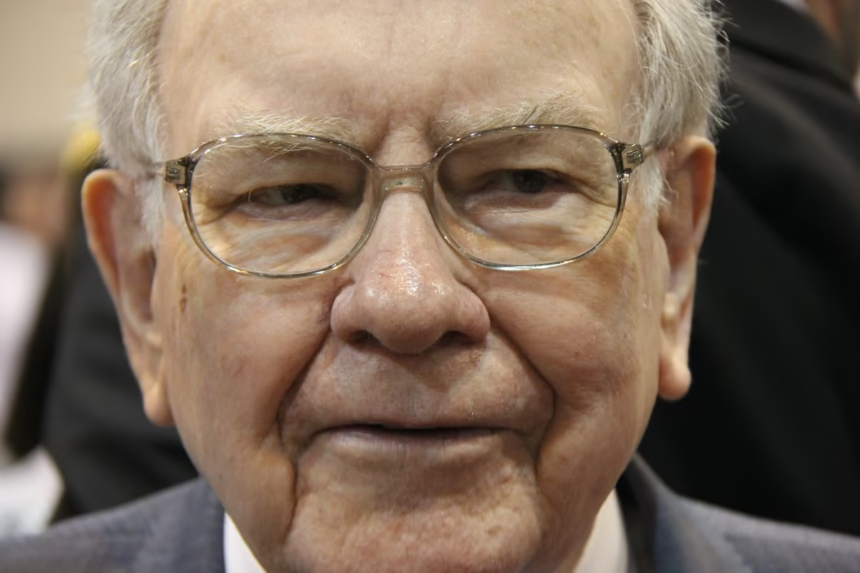
For over 50 years, Warren Buffett led Berkshire Hathaway, transforming it into a trillion-dollar enterprise. During his remarkable tenure as CEO, known as the Oracle of Omaha, he achieved an astounding cumulative return exceeding 6,000,000% on Berkshire’s Class A shares, vastly outperforming the S&P 500, the Dow Jones Industrial Average, and the Nasdaq Composite.
However, it is now clear that the end of an era has arrived, as Buffett officially stepped down as CEO on December 31, 2025, while continuing to serve as chairman. His retirement marks a significant transition for the conglomerate and investors alike.
Despite relinquishing control over Berkshire’s daily operations and its extensive investment portfolio valued at $319 billion, the influence of Buffett’s leadership remains paramount. Recent quarterly operating results released on February 28 indicate that his final warning—a staggering $373 billion in cash reserves—could signal important trends for Wall Street moving forward.
Noteworthy is that throughout the final 13 quarters before his retirement, Buffett consistently sold stocks. In fact, his net stock sales totaled $186.7 billion over nearly three years, with the last quarter alone accounting for $3.16 billion. This trend of selling, combined with earnings generated by companies under Berkshire’s umbrella like BNSF and GEICO, has led to a surge in cash reserves, which ballooned to a near-record $373.3 billion by the end of 2025.
The implications of this cash accumulation cannot be understated. Buffett’s choice to hold onto cash rather than heavily invest raises questions, especially given the stock market’s current valuations. With the so-called Warren Buffett Indicator hitting an unprecedented 224% in January 2026, many observers note that this reflects the most inflated stock market valuations in history. Historically, when this ratio has soared, subsequent major corrections in the stock market have usually followed, raising alarms for future investors.
The market’s historical trends indicate a divergence, with the S&P 500 experiencing impressive gains over the past several years, underpinned by technological advancements and strong corporate performance. However, Buffett’s apprehension appears justified, as the stock market remains expensive by historical standards. Buffett has previously pointed out that the market cap-to-GDP ratio—a key metric he trusts for evaluating stock prices—has averaged around 87% since 1970. The current state, exceeding 221%, presents a stark contrast.
Additionally, the S&P 500’s Shiller Price-to-Earnings (P/E) Ratio has been hovering between 39 and 41, far above its historical average of approximately 17.3. Such high valuations underscore the market’s volatility and the potential for significant downturns.
Buffett’s methodical approach to investing teaches one vital lesson: patience can be a powerful ally. Throughout his long career, Berkshire has strategically weathered market corrections and acknowledged that downturns are integral to the investing landscape. Taking calculated risks during periods of market decline has offered Buffett opportunities to acquire quality businesses at attractive valuations, a strategy that he appears to have employed leading up to his retirement.
As his successor, Greg Abel prepares to take charge, he inherits not only Buffett’s invaluable legacy but also a significant reservoir of capital. This financial buffer positions Berkshire Hathaway favorably to capitalize on market disruptions when valuations inevitably revert to more appealing levels. Thus, while the immediate outlook may seem cautionary, history has shown that adept management and strategic foresight can lead to fruitful opportunities in the long term.