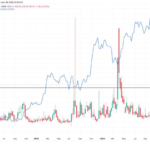
Market participants analyzing the future of Bitcoin may want to pay attention to the gold-to-Bitcoin ratio, according to insights from Jurrien Timmer, Fidelity’s Director of Global Macro. On February 27, he recommended that this ratio be utilized as a measure for gauging Bitcoin’s performance, categorizing the cryptocurrency as a secondary play within the so-called hard-money narrative, akin to silver.
Timmer presented a chart reflecting the 52-week Z-score for the gold-to-Bitcoin ratio, asserting that gold is currently “expensive” in relation to Bitcoin, though not yet reaching levels typically associated with past peaks. Historically, these peaks have marked significant turning points for the digital asset. Currently, the gold-to-Bitcoin ratio reads at a Z-score of 91%, with previous peaks exceeding the 100% threshold.
“This suggests to me that Bitcoin will need to spend more time backing and potentially filling at the $60-$70k level, and perhaps even slightly undercut it, to satisfy both the time and price elements of a mild Bitcoin winter,” he explained.
Despite these assessments, Bitcoin has begun to show signs of resilience. Recently, its price surged by as much as $10,000, driven by military actions involving the U.S. and Israel against Iran, pushing Bitcoin above the $70,000 mark for the first time in a month.
Investment chief Arthur Hayes of Maelstrom commented that the ongoing military campaign has the potential to elevate Bitcoin’s price. He noted that the longer such events persist, the greater the likelihood that the Federal Reserve may opt to lower interest rates.
In December, Timmer had forecasted a downturn for Bitcoin this year, attributing the prediction to its historical four-year cycle and gold’s stronger performance in comparison.
As investors look beyond Bitcoin, platforms are providing diverse options for portfolio construction that cover real estate, fixed-income opportunities, precious metals, and more, allowing for risk management and stable returns.
With developments across various industries, including innovative energy solutions, luxury behavioral health, and cutting-edge technology firms, there are intriguing opportunities for investors seeking exposure to alternative assets and diverse markets. Companies like Paladin Power and Valley Center Wellness are addressing significant consumer needs, while tech innovators such as Rad AI and Immersed are leveraging advances in AI and remote work to capture market share.
Whether through fractional real estate investing, art ownership, or diversified ETFs, market participants are increasingly considering strategies that facilitate wealth accumulation across various asset classes. As the financial landscape continues to evolve, this multifaceted approach to investment may offer a pathway to mitigate risk and achieve long-term financial goals.