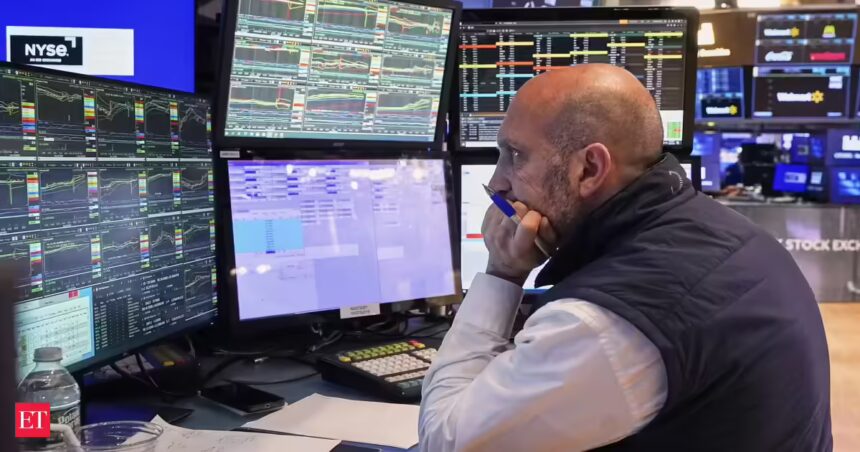
Investors are bracing for a potentially tumultuous week ahead as they ponder whether the U.S. stock market might experience a significant decline when trading opens Monday. The question arises after Wall Street concluded the previous week on a negative note, with the Dow Jones Industrial Average, the S&P 500, and the Nasdaq all closing lower on Friday. Market participants are keenly observing the interplay of several factors that have contributed to this unease, including disappointing jobs data and a sudden spike in oil prices.
Rising oil prices have become a focal point of concern for investors, with crude oil futures surging more than 12 percent to breach the $90 per barrel mark. This escalation followed tensions in the Middle East, particularly disruptions in the Strait of Hormuz, a critical path for global oil transportation. The situation has triggered fears of inflated energy costs, which could further strain consumers and exacerbate inflationary pressures in the U.S. economy.
The unsettling backdrop was compounded by a weak jobs report indicating that the U.S. economy unexpectedly lost 92,000 jobs in February, contrary to expectations of a modest increase. The unemployment rate also ticked up to 4.4 percent from 4.3 percent the prior month. Such data has left investors wary, signaling potential slowdown in economic growth and raising alarms about the stability of the labor market.
On Friday, the three major U.S. indices reflected this anxiety. The Dow Jones dropped by 0.95 percent to close at 47,501.55, while the S&P 500 fell 1.33 percent to 6,740.00. The Nasdaq Composite witnessed the sharpest decline, down 1.59 percent to finish at 22,387.68. Analysts warn that if economic indicators remain weak and oil prices continue to rise, the market may face persistent pressure.
The outlook among analysts suggests that while a sharp crash isn’t guaranteed, volatility may persist as investors navigate the complex landscape. Kristina Hooper from Man Group expressed concerns that prolonged geopolitical tensions could complicate the Federal Reserve’s plans for interest rate cuts. Initially, many anticipated the Fed might begin easing rates in June, but this outlook has since shifted largely to September as inflation continues to loom as a critical risk due to rising energy costs.
The Cboe Volatility Index, a barometer of market anxiety, rose to 29.49—its highest level since April 2022—signifying heightened investor apprehension. As some sectors, particularly energy, benefitted slightly from higher oil prices, others such as banking and travel stocks took hits. The S&P 500 Banks Index, for instance, fell by 2.03 percent, while airline stocks also dropped amid increasing fuel costs.
Moving forward, experts advise investors to focus on long-term trends instead of reacting impulsively to daily market fluctuations. Monitoring developments concerning oil prices, geopolitical tensions, and forthcoming economic data will be crucial for understanding market potential. Analysts underscore the importance of diversification and risk management, noting that while markets can rebound after periods of uncertainty, caution is essential until energy markets stabilize and clearer economic signals emerge.