









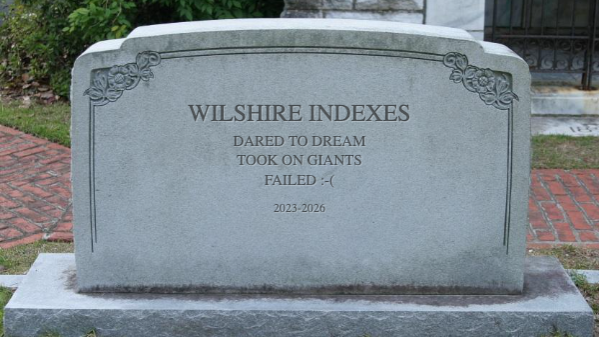
Incumbency plays a crucial role across various industries, yet few sectors illustrate this dynamic more starkly than financial indexing. Recent developments have underscored the challenges faced by smaller indices in an arena dominated by a few key players.
Over the weekend, a post by Mark Makepeace, CEO of Wilshire Indexes, sparked some intrigue on LinkedIn, although it has since been deleted. Reports indicate that the UK segment of Wilshire Indexes has entered administration. Adding to the uncertainty, several senior employees have updated their profiles to reflect that they are “Open to Work,” with Makepeace sharing these updates. Various press outlets have reiterated this situation, prompting speculation about its accuracy. While attempts to reach Makepeace and Wilshire Indexes for clarification yielded only a vague statement regarding the administration of “Wilshire OpCo UK” and “Wilshire TopCo Limited,” the statement did confirm the sale of important company assets.
This development paints a somber picture for those invested in the indexing sector. The notion of dismemberment and asset liquidation invokes a stark contrast to more conventional divestitures. It highlights the increasingly challenging landscape for indexing firms that lack the stature of leaders like S&P Dow Jones Indices, MSCI, or FTSE Russell.
Wilshire Indexes, although perhaps not a household name, has a rich history in the financial indices arena. Its introduction of the “total stock market” index in 1974 was revolutionary, aiming to capture the entire US equity market rather than just a representative segment. At that time, dominant indices like the Dow Jones Industrial Average and S&P 500 were criticized for their design flaws, with the Dow’s methodology particularly often dismissed due to its reliance on nominal stock prices.
Despite its innovative beginnings, Wilshire’s prominence diminished over the years, particularly after key partnerships that initially boosted its visibility. The Vanguard Total Stock Market Index Fund, which employed the Wilshire 5000 as its benchmark in the early ’90s, eventually pivoted to other indices, further illustrating how market dynamics can shift. After Dow Jones took over the management of the Wilshire 5000 in 2004, the index’s association with prominent funds began to fade, culminating in Vanguard’s choice to adopt an MSCI benchmark in 2005.
Despite attempts to revive the company’s relevance, including Makepeace’s endeavors to reshape Wilshire Indexes into a formidable industry contender after its acquisition by private equity firms in 2021, it appears that breaking the stronghold of the existing index leaders remains an uphill battle. While companies like Morningstar have made strides to expand their indexing capabilities, the challenges posed by the entrenched oligopolistic nature of the industry cannot be overstated.
The unwavering dominance of the Big Three—S&P, MSCI, and FTSE Russell—creates a challenging environment for competitors. Despite the proliferation of over three million public market indices, the industry appears to resist significant disruption. Regulatory concerns also discourage companies from engaging with smaller or less established index providers, favoring the safer option presented by the larger entities.
In a landscape characterized by high profit margins—NASDAQ alone generated $827 million from its benchmarks last year—the demand for reliable benchmarks remains strong. As the outlook for Wilshire Indexes unveils the broader dynamics at play in the financial indexing industry, it appears that the likelihood of new entrants substantially altering the competitive landscape remains low. The industry’s future is likely to remain dominated by its established players, reinforcing the challenges faced by would-be disruptors.