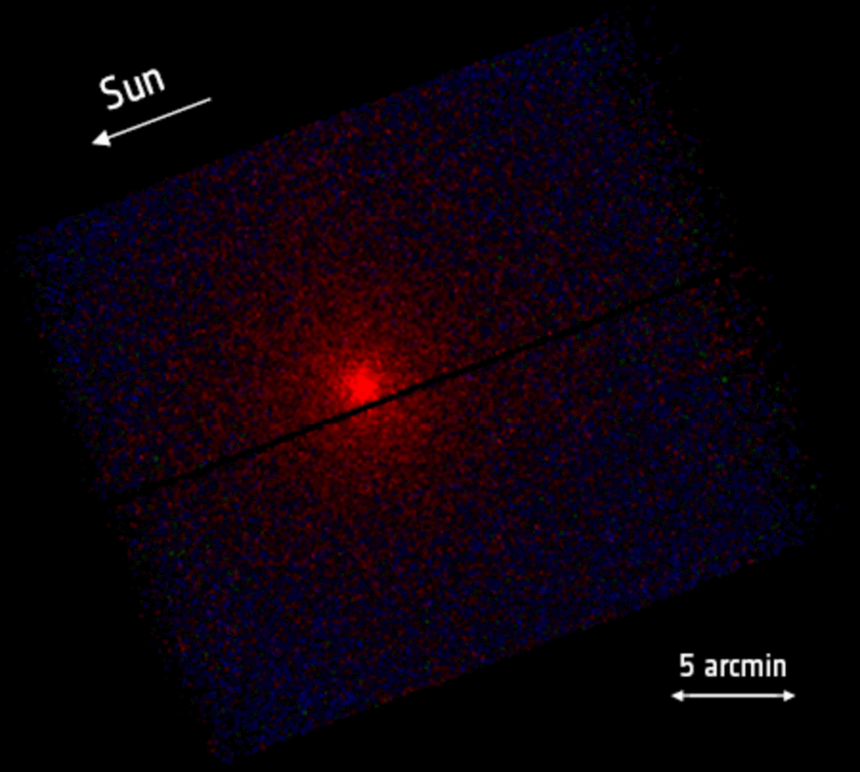
The European Space Agency’s XMM-Newton space observatory recently conducted a 20-hour observation of interstellar comet 3I/ATLAS on December 3. At the time of the observation, the comet was situated approximately 282 to 285 million kilometers away from the spacecraft. Utilizing its European Photon Imaging Camera (EPIC)-pn camera, XMM-Newton captured a remarkable image of the comet glowing in low-energy X-rays.
In the captured image, a bright red spot indicates the comet’s X-ray emissions, contrasted against a dark background that denotes regions with minimal X-ray activity. The red highlights represent the comet’s gas interactions, which are expected to produce X-rays when gas molecules from the comet collide with the solar wind. This phenomenon has been previously evidenced, with telescopes like the James Webb Space Telescope and NASA’s SPHEREx detecting gases such as water vapor, carbon dioxide, and carbon monoxide, which contribute to these emissions.
X-ray observations are particularly valuable because they reveal the presence of gases that are difficult to detect using optical or ultraviolet instruments, such as those on the Hubble Space Telescope or ESA’s JUICE. This capability enables scientists to delve deeper into the composition of interstellar objects. Current hypotheses suggest that the first detected interstellar object, 1I/’Oumuamua, might have been composed of exotic ices like nitrogen or hydrogen. Although that object is now too distant for further study, 3I/ATLAS offers a fresh opportunity for investigation.
The ongoing observations of 3I/ATLAS in X-ray light will complement other data, potentially allowing researchers to shed light on the comet’s composition. For those interested in further updates or frequently asked questions about comet 3I/ATLAS, the ESA has made information accessible at esa.int/3IATLAS.
The X-ray image importantly illustrates the differences in gas detection capabilities between various observational methods, emphasizing the critical role X-ray astronomy plays in advancing our understanding of distant celestial bodies.