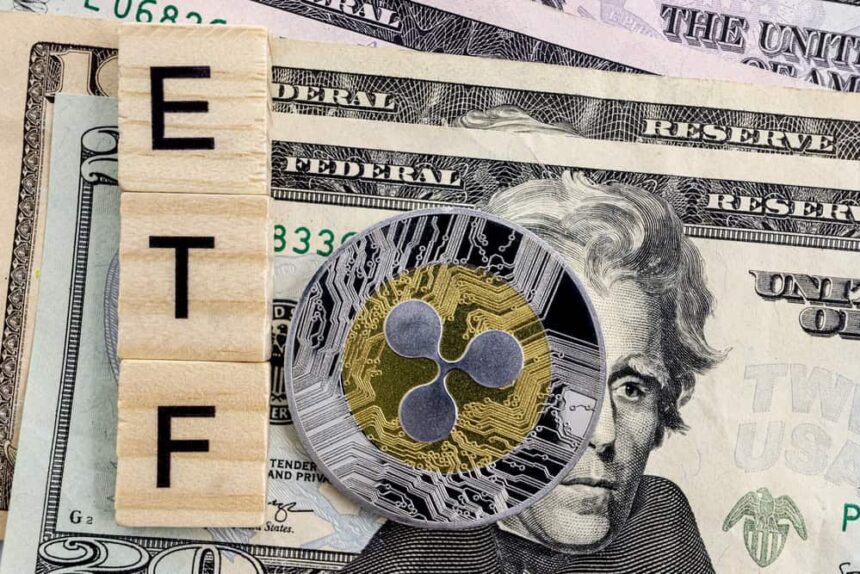
XRP’s recent rise above $2.50 has sparked considerable interest among crypto traders, driven by a plethora of spot ETF filings from major asset managers. Notable companies like Franklin Templeton, Bitwise, and 21Shares have submitted applications, fueling hopes for regulatory approval before the end of November. The atmosphere around XRP is electric, as traders are closely monitoring the token amid growing institutional interest and increasing trading volumes, sparking discussions on whether it could soon challenge the $3 mark.
The journey to this latest price point has been tumultuous for XRP. Starting at about $2.55 in mid-May 2025, the token dipped to a low of $2.12 in late June but enjoyed a noticeable uptrend through July, peaking at $3.28 in early August, just shy of its all-time high of $3.65 recorded on July 18. Following this summer surge, XRP faced corrections in September and October that pulled it back to around $2.36 before stabilizing in the current range of $2.48 to $2.53. Despite this volatility, XRP has surged over 320% in the past year, setting the stage for its next significant move.
The recent influx of ETF filings has injected renewed vitality into the crypto market. The Depository Trust & Clearing Corporation (DTCC) has recognized several spot XRP ETFs from leading issuers as of November 7. While these products are still awaiting SEC approval, the pre-launch phase has piqued traders’ interest, reminiscent of the pre-approval period leading up to the launches of Bitcoin and Ethereum ETFs earlier this year. Analysts from Bloomberg currently estimate a 95% chance of approval, suggesting more favorable regulatory conditions. If cleared, these ETFs could usher in billions in institutional investment, potentially boosting XRP’s liquidity and integrating it into mainstream investment portfolios.
Among the driving forces behind XRP’s momentum is Ripple’s deepening presence in the global financial landscape. Ripple President Monica Long emphasized the growing interest in blockchain solutions from major banking institutions like Bank of America. Ripple’s recent expansions, including the acquisitions of Hidden Road and GTreasury, as well as the launch of Ripple Prime—an institutional trading platform—are indicative of its goal to bridge the gap between cryptocurrency and traditional finance. With compliant access to XRP and Ripple USD (RLUSD), institutions are becoming increasingly willing to engage with this asset.
As XRP approaches the pivotal $3 threshold, it faces significant technical challenges. The $2.60 to $2.80 range is crucial resistance, with $3.00 serving as a key psychological and structural barrier. A sharp breakout above this level could propel XRP into a rally towards $3.30 to $3.60. Current consolidation patterns indicate strong accumulation, while recent higher lows suggest potential for further gains, although short-term pressure is still evident from declining moving averages. Rising volume and institutional involvement will be critical for any forthcoming breakout.
Looking ahead to 2026, XRP’s trajectory will likely hinge on continued momentum from ETF developments, Ripple’s institutional growth, and the enduring regulatory clarity that sustains demand. Analysts present three potential scenarios for XRP’s future performance:
-
Bullish Case: Successful ETF launches, increasing institutional flows via Ripple Prime, and ongoing partnerships with key financial institutions could drive XRP to $3.80 to $5 by the end of 2026. Sustained adoption of Ripple’s payment network would solidify XRP’s role as a compliant bridge asset for cross-border transactions.
-
Base Case: A more moderate outlook sees XRP fluctuating between $2.40 and $3.00, with ETF approvals attracting stable, but not overwhelming, inflows. Ripple’s growing utility through its financial services might support steady adoption, yet market sentiment could prioritize consolidation over significant upward movement.
-
Bearish Case: In the absence of sustained momentum, XRP could retreat to the $1.60 to $2.00 range, particularly if ETF approvals are delayed or if regulatory challenges arise. A temporary cooling of institutional interest could lead to short-term price declines, although XRP’s enhanced fundamentals and expanding real-world applications should maintain strong long-term confidence.
In conclusion, while XRP currently stands at an exciting crossroads, the coming months may prove pivotal in shaping its long-term market position and resilience within the evolving landscape of cryptocurrency and traditional finance.