Bitcoin has continued to hover in a restrictive range between $110,000 and $120,000, currently priced at $112,976.17, while gold and U.S. equities are nearing historical highs. Recent analysis from Glassnode reveals a notable trend in the cryptocurrency market, specifically pointing to significant selling pressure across various wallet groups.
The Accumulation Trend Score by cohort, as calculated by Glassnode, indicates the relative strength of accumulation or distribution among different wallet sizes over the past 15 days. The metric traditionally measures the buying or selling patterns among holders, with a score nearing 1 signaling accumulation and a score closer to 0 indicating distribution. Notably, this analysis excludes activities from exchanges and miners.
Currently, all cohorts—from wallets holding less than 1 Bitcoin to large holders or “whales” with over 10,000 BTC—are exhibiting signs of distribution. The largest whale group has been particularly active, showcasing aggressive selling behaviors that have persisted over the past year.
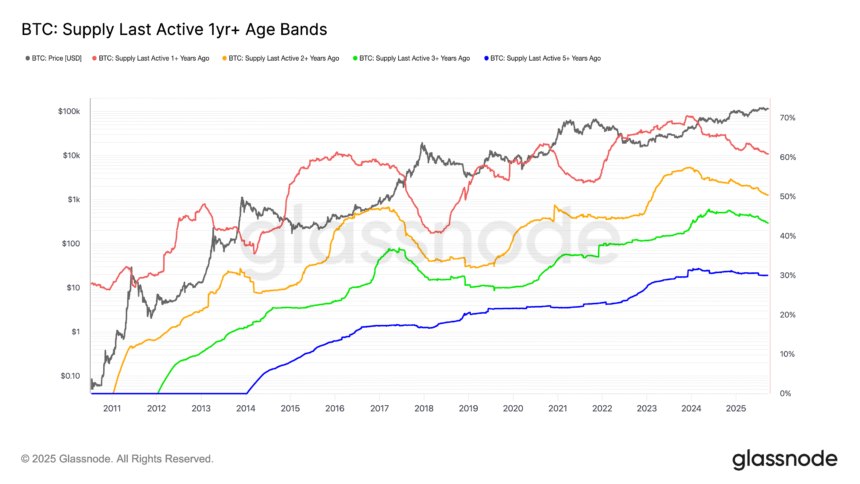
In examining the long-term holder supply, significant shifts are present. The percentage of the circulating Bitcoin supply that has remained unmoved for at least a year has dramatically decreased from 70% to 60%. This drop follows a peak in November 2023, coinciding with Bitcoin’s trading upward near $40,000. In conjunction, holders who have retained Bitcoin for more than two years have also started to sell, bringing their share down from 57% to 52%.
Meanwhile, the cohort of holders with Bitcoin for three years or more has consistently declined since November 2024, dropping to just above 43%. This group largely comprises investors who entered the market during the previous cycle peak in November 2021, when Bitcoin reached approximately $69,000. Many of these holders took advantage of lower prices during the 2022 bear market when Bitcoin fell to around $15,500, and are now realizing gains as prices recover.
In contrast, the portion of holders with Bitcoin for five years or more remains stable, indicating that long-term investors are opting not to participate in this wave of selling. The patterns suggest that those who are currently sitting on unrealized profits from this cycle are increasingly cashing out, further contributing to ongoing selling pressure in the market.
As market dynamics continue to evolve, these trends signal a cautious outlook for Bitcoin’s near-term performance amid a backdrop of historically high asset valuations in other markets.