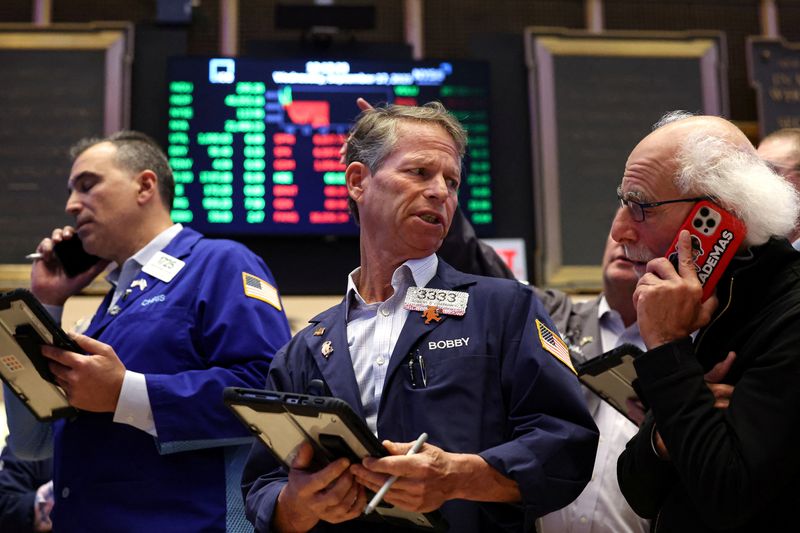
Wall Street experienced a positive trading day on Monday, with the Nasdaq index leading the charge as investors showed optimism towards technology stocks. This upbeat sentiment appeared resilient in the face of potential uncertainties, including the looming threat of a U.S. government shutdown and comments from Federal Reserve officials indicating a cautious stance on monetary policy.
Technology stocks significantly boosted the benchmark S&P 500 as market participants leaned into shares projected to benefit from advancements in artificial intelligence. Moreover, speculation regarding possible interest rate cuts by the Federal Reserve due to ongoing inflation and labor market challenges also fueled investor confidence.
This week, attention on Wall Street shifts towards a contentious funding debate between Republicans and Democrats, which raises concerns over a possible government shutdown starting Wednesday, the first day of the new fiscal year for the U.S. government. The impending shutdown has created a state of unease; however, analysts suggest that investors are focusing more on potential positive outcomes than on the risks involved. Lindsey Bell, chief strategist at 248 Ventures, emphasized the market’s current resilience, noting that it seems to be prioritizing rate easing expectations and recent positive economic indicators, such as robust housing and consumer spending data.
While shutdowns have historically had little impact on corporate earnings, the current stalemate may be dampening gains and limiting trading volume, observed Burns McKinney, portfolio manager at NFJ Investment Group. McKinney stated that historically, brief government shutdowns do not usually affect company profitability, highlighting that investors remain focused on long-term gains.
In terms of market performance, the Dow Jones Industrial Average climbed 68.78 points to finish at 46,316.07, while the S&P 500 rose by 17.51 points, reaching 6,661.21. The Nasdaq Composite saw a significant increase of 107.09 points, closing at 22,591.15.
Market participants also monitored comments from Federal Reserve officials, notably Cleveland Fed President Beth Hammack, who advocated for sustained restrictive monetary policy to address inflation concerns. On the other hand, St. Louis Federal Reserve President Alberto Musalem, a voting member this year, expressed openness to further interest rate reductions while cautioning that the Fed must keep its rates sufficiently high to control inflation, which remains around one percentage point above the central bank’s targeted 2%. The market, however, shows a strong inclination towards expecting a 25-basis-point cut in the upcoming Fed meeting, with a nearly 89% probability according to CME Group’s FedWatch tool.
In sector performance, nine of the eleven major S&P industry sectors saw gains. The energy sector lagged, dropping 1.9% as oil prices fell by more than 3%. Consumer discretionary stocks led the gains with an increase of 0.6%, while technology stocks experienced notable lifts, especially from AI chip leader Nvidia, which rose by 2%, and Microsoft, which added 0.6%. In a significant corporate development, Electronic Arts shares surged 4.5% following a $55 billion deal to take the company private, fueling optimism about further mergers and acquisitions.
Other notable performers included Lam Research, which gained 2% following a rating upgrade from Deutsche Bank, and AppLovin, which closed up 6.3% after setting a new record high. The company’s target price was raised significantly by Morgan Stanley, contributing to the positive momentum. The cannabis sector also witnessed a surge after U.S. President Donald Trump promoted the health benefits of hemp-derived cannabidiol, with companies like Canopy Growth and Cronos Group seeing notable increases.
Overall, advancing issues outnumbered decliners on the NYSE by a ratio of 1.38-to-1, signaling a generally positive sentiment in the market. This momentum was further evidenced by the 337 new highs and 80 new lows recorded on the NYSE, alongside 38 new highs and six new lows in the S&P 500, and a more expansive 116 new highs against 74 new lows in the Nasdaq Composite. Trading volume on U.S. exchanges totaled approximately 17.91 billion shares, slightly lower than the 20-day average of 18.25 billion.