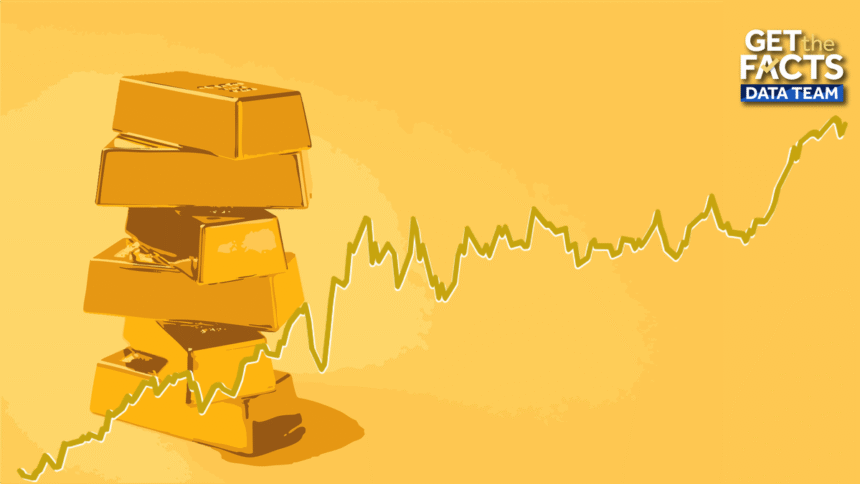
Gold prices have surged dramatically, edging closer to the $4,000 mark. This precious metal, historically revered as a store of value, has seen a remarkable increase of 45% this year alone, rising from $2,669 in January. Anticipation surrounding the potential for a U.S. government shutdown has contributed to the recent uptick, as investors once again turn to gold amid economic uncertainty.
Gold’s reputation as a “currency of kings” stems from its unique properties; it is durable, malleable, and resistant to tarnish. In recent years, it has evolved from a primary trade item to a preferred safe-haven asset. Unlike stocks or bonds, gold can be physically held and exchanged as needed.
During the 2008 global financial crisis, many central banks, realizing the risks of relying solely on U.S. dollars, began to diversify into gold. Professor Andrea Bubula from Columbia University highlights a pivotal moment in 2009, during the Venezuelan banking crisis, when property rights were threatened. This experience prompted central banks to reassess their reserve strategies. Bubula notes, “Gold is good because it is typically negatively correlated with markets; when markets do badly, gold does well.”
Recent data from the World Gold Council indicates that central banks have doubled their gold reserves in the last three years, increasing them to approximately 1,000 tons from a prior average of 400-500 tons. Taylor Burnette, research lead for the Americas at the Council, categorizes gold demand into three segments: jewelry and technology, individual investors, and central banks. This year, investor demand has driven market trends, with individuals, including family offices and high-net-worth investors, seeking to diversify their portfolios.
Burnette indicates that an average allocation of gold in an investment portfolio typically ranges between 2% to 10%, often settling around 5%. Gold’s liquidity stems from its standardized weight and purity, making it a straightforward asset to trade without carrying credit risk.
Several external factors contribute to the current rally in gold prices. The weakening U.S. dollar has been a significant driver; data reveals a decline of over 10% in the dollar index since the beginning of the year. This trend coincides with downgrades from major credit-rating agencies regarding the U.S. government’s creditworthiness. Bubula explains that when the dollar weakens, gold prices tend to rise, as it takes more dollars to acquire the same amount of gold. This inverse relationship also applies across international currencies, making gold’s value attractive regardless of exchange rates.
The World Gold Council’s quarterly report confirms a rise in total gold demand to 1,249 metric tons, a 3% increase compared to the previous year. Notably, gold Exchange-Traded Funds (ETFs) represented a substantial portion of the demand, accounting for 170 metric tons in the latest quarter. Stellar investment flows have been bolstered by an unpredictable geopolitical landscape, spurring continued interest in gold as a reliable asset.
Bubula notes that investors often buy gold to mitigate potential losses compared to stock or bond investments, especially given the predominantly bearish sentiment observed in recent weeks through the AAII Sentiment Survey.
Nevertheless, gold is not without its drawbacks. Costs associated with storage and insurance, along with the risk of theft, can detract from its appeal. Moreover, gold does not yield interest or dividends, unlike stocks or bonds. As Bubula points out, financial assets possess certain benefits that gold does not offer.
As gold approaches unprecedented price levels, the dynamics of supply, demand, and economic conditions will continue to influence its role in investment strategies worldwide.