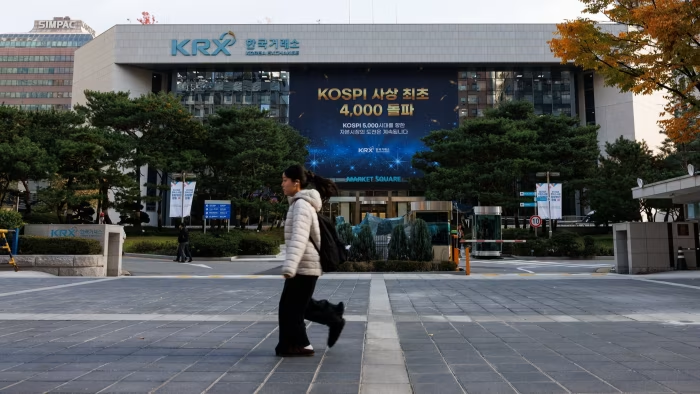
South Korean retail investors are increasingly shaping the landscape of U.S. equity markets, engaging in high-stakes trading strategies that have become a hallmark of their domestic trading culture. This year, South Korean traders have seized upon the growing momentum in U.S. markets, contributing significantly to wild price fluctuations of several high-profile stocks. Data from the Korea Securities Depository indicates that South Korean holdings of U.S. equities have surged to approximately $170 billion by the end of October, nearly double the amount from the previous year.
As many investors flock to the resurgence of meme stocks—a trend that initially gained traction during the Covid-19 pandemic—experts highlight the increasingly dominant role that South Korean traders play in this phenomenon. Seiwoon Hwang, a senior research fellow at the Korea Capital Market Institute, noted that “Korean retail investors are strengthening the meme stock phenomena in the U.S. stock market.” This aligns with the characteristics of South Korea’s own stock environment, where speculative retail trading accounts for over half of daily turnover in a market valued at around $2 trillion.
Portfolio manager Owen Lamont from Acadian Asset Management expressed concerns that the influx of speculative investment from South Korea could lead to distorted valuations in the U.S. markets. He previously published an article titled “The Squid Game stock market,” drawing parallels between the reckless behavior seen in investment patterns and the themes of the popular Netflix series. He pondered whether the U.S. might eventually mirror South Korea’s trading behaviors, stating, “They’ve been doing it [buying speculative stocks] in Korea for many years. It could be America’s future.”
The surge in South Korean investments is exemplified by the case of IonQ, a loss-making quantum computing firm, whose stock saw a staggering rise of about 370 percent between March and its peak in October. South Korean investors owned a significant stake in the company, totaling around $4.4 billion out of $20 billion market capitalization at the end of October. Jongmin Shim from CLSA characterized these investors as particularly aggressive compared to their global counterparts, asserting, “Korean retailers are just crazy.”
Beyond the headlines of soaring stocks, there are also narratives of risk and loss. For instance, South Korean traders collectively invested approximately $239.2 million in Beyond Meat, a company that has faced dramatic volatility throughout the month, experiencing wild price swings that contributed to a current market cap of around $960 million. Lamont remarked on the intensifying speculation in U.S. markets, stating, “The lunatic fringe [of very speculative stocks] is getting more crazy and bigger.”
While the South Korean stock market has performed well this year, bolstered by rising optimism in AI and corporate governance changes, many investors remain skeptical of its sustainability. With the Kospi—a key index of South Korea—having nearly doubled in the past decade, South Korean investors view the U.S. markets as a more lucrative alternative, especially in light of their home market’s underperformance relative to Wall Street.
A high level of wealth inequality and steep property prices are pushing ordinary South Koreans toward higher-risk investments, reported Shim, emphasizing that many feel compelled to seek quick financial gains amid a competitive economic landscape. Chung Ji-eun, a 37-year-old financial employee, exemplifies this trend. She has invested about 600 million won (approximately $410,000) across a range of U.S. stocks including major players like Tesla and UnitedHealth, as well as smaller firms like Intuitive Machines and Chime Financial.
Despite incurring losses, Chung remains committed to her investments, stating, “There is no better way to make a lot of money as a salaried worker, given low interest rates.” Her trading activity often involves late-night sessions due to the 14-hour difference in time zones. “Dopamine keeps me awake late into the night,” she said, illustrating the addictive nature of trading in this dynamic environment.
As South Korean retail investors continue to embrace the volatility of the U.S. markets, analysts and traders alike are watching closely. Their strategies and behaviors could not only reshape their domestic market but potentially influence global investor practices as well.