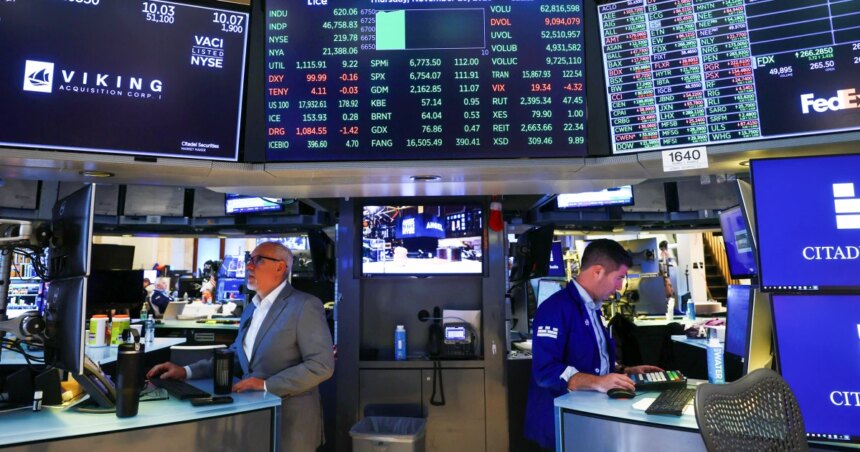
The major U.S. stock indexes concluded the week on a positive trajectory, recouping some losses though they were still short of fully reversing the week’s downturns. On Friday, the S&P 500 gained 1%, while the tech-heavy Nasdaq Composite Index saw a rise of 0.9%. The Dow Jones Industrial Average experienced a significant uplift, soaring nearly 500 points. This optimistic finish came after a challenging week marked by widespread concerns regarding the U.S. labor market and the ability of leading technology companies—crucial contributors to this year’s market gains—to substantiate their substantial investments in artificial intelligence.
Despite the Friday surge, the S&P 500 closed out the week down approximately 1.8%, although it remains up around 12% year-to-date. Similarly, the Nasdaq reported a weekly downturn of 2.7%, yet has recorded an annual increase of about 15%. Key to the volatility were two major U.S. companies: Nvidia and Walmart. Nvidia, which has ascended to become the world’s most valuable company due to its significant role in the AI chip market, provided a boost on Wednesday with strong earnings. Then, on Thursday, Walmart’s earnings reinforced this positive sentiment.
However, the week was also shadowed by a mixed jobs report revealing that while a solid 119,000 jobs were added in September, there were downward revisions for prior months alongside a slight uptick in the unemployment rate. This data casts a more pessimistic outlook on the economy. The persistent inflation challenges, combined with a job market that, while not alarming, is not sufficiently robust either, have placed the Federal Reserve in a complicated position concerning interest rate settings. Generally, rate cuts facilitate easier borrowing across the economy, which tends to enhance investor interest in stocks.
Expectations for an interest rate cut had notably decreased by Thursday, but they received a boost on Friday after New York Federal Reserve President John C. Williams suggested that another rate cut may be warranted. Earlier in October, the Fed had already cut its benchmark interest rate for the second time this year. Meanwhile, former President Donald Trump has been advocating for even more significant rate reductions.
According to CME Group’s FedWatch, which monitors trader expectations regarding rate cuts, the probability for a reduction rose to over 70% on Friday, significantly up from 39% the previous day but down from 98% earlier in October. These fluctuations highlight the current instability in economic sentiment.
While Wall Street faced its share of challenges, crypto investors encountered a tougher plight. Bitcoin continued its downward slide on Friday, briefly dipping below the $80,000 mark before recovering somewhat to around $84,000. This marks a decline of approximately 12% for the week, well below its all-time high of over $126,000 reached in October.