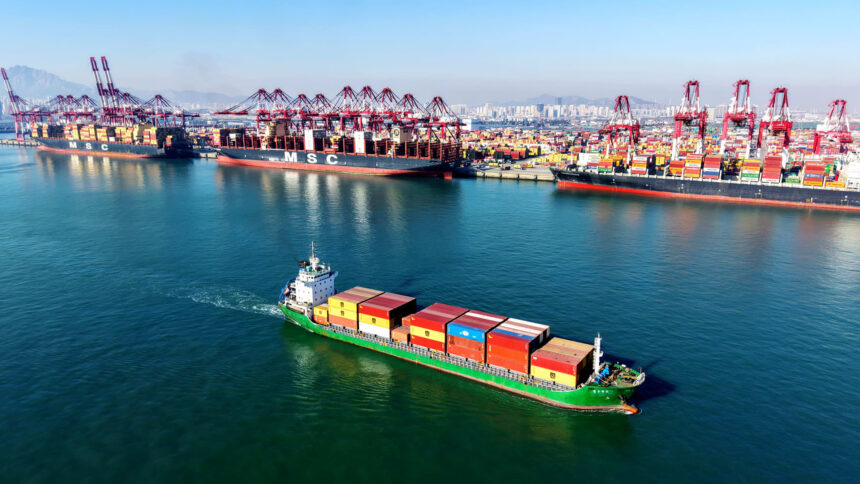
A cargo ship loaded with containers recently departed from Qingdao Port in Shandong Province, marking the ongoing complexities in China’s trade landscape. Despite a relatively fresh trade agreement between the United States and China, outbound shipments to the U.S. continued to decline for the eighth consecutive month. This situation contrasts with overall exports, which experienced a surprising upswing in November, surpassing market expectations.
According to customs data released recently, China’s exports surged by 5.9% in dollar terms from a year earlier, exceeding economists’ forecasts of 3.8%. This marked a noteworthy recovery from an unexpected contraction of 1.1% in October, which had been the first decline since March 2024. However, the news wasn’t uniformly positive, as imports increased by just 1.9%, falling short of the expected 3% increase. This shortfall is attributed to ongoing challenges in domestic consumption, evidenced by a persistent housing downturn and rising job insecurity.
Chinese officials have reiterated their commitment to boosting imports and balancing trade amid increasing criticism regarding aggressive export strategies. Unfortunately, shipments to the U.S. saw a significant decline, plummeting by 28.6% in November, echoing a trend of double-digit declines that began months ago. Meanwhile, imports from the U.S. also contracted, decreasing by 19% compared to the previous year.
Experts like Gary Ng, a senior economist at Natixis, attribute this ongoing downturn to elevated tariffs that the U.S. maintains on Chinese goods. Despite a recent trade truce, these tariffs average around 47.5%, significantly higher than those applied to many other nations. Conversely, tariffs on U.S. imports into China stand at approximately 32%. Year-to-date, exports to the U.S. from China have declined by 18.9%, with imports showing a similar trend, decreasing by 13.2%.
In contrast to the U.S. market, China’s exports to other regions, particularly the European Union and the Association of Southeast Asian Nations (ASEAN), showed robust growth, with increases of over 8% and nearly 15%, respectively. Overall exports for the first 11 months of the year grew by 5.4% year-on-year, while imports fell by 0.6%, resulting in a record trade surplus of $1.076 trillion.
Following the trade agreement established in October, which aimed at reducing tariffs and enhancing cooperation on critical imports like soybeans, China’s rare earth exports also saw significant increases. In November, shipments of these essential minerals rose by 24% compared to the previous year. However, imports of soybeans, while increasing by 13%, indicated a slower start in achieving the pledged target of 12 million metric tons from the U.S. by year-end.
Looking ahead, Chinese policymakers are set to convene for the annual Central Economic Work Conference to discuss economic priorities for the coming year. Analysts believe that the rebound in export growth could help offset weak domestic demand, positioning the economy favorably to achieve the target of approximately 5% growth for the year.
However, projections indicate that maintaining a stable growth target in 2026 will necessitate gradual policy easing to stimulate an economy facing sluggish indicators. Notably, factory activity in November contracted for the eighth month in a row, and new orders continued to shrink, generating concerns about future manufacturing stability.
In recent weeks, the yuan has strengthened, though this increase has not sufficiently curbed the export flow. A stronger yuan could potentially enhance household purchasing power and shift economic dependence from exports to domestic consumption. Experts suggest that this pivot is crucial for maintaining sustainable economic growth in the long run.