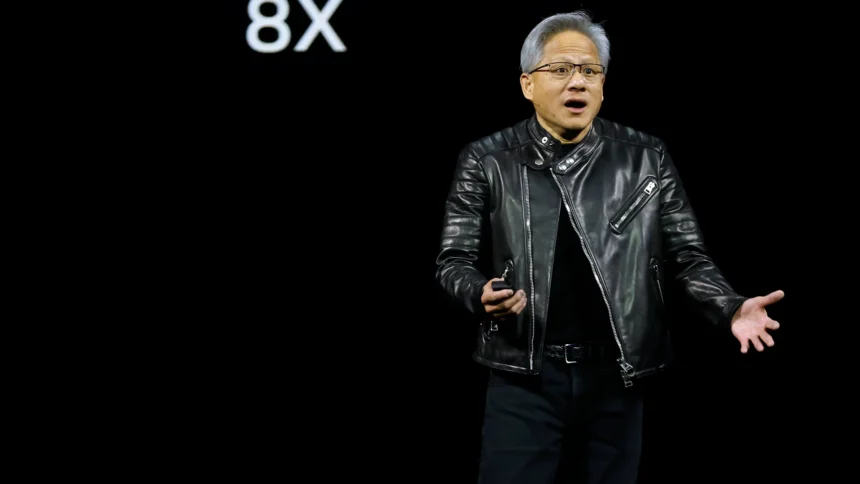
In a notable shift in the discourse surrounding Bitcoin, Nvidia CEO Jensen Huang has voiced a fresh perspective on the cryptocurrency’s contentious energy consumption. Speaking on a panel focused on the intersections of artificial intelligence and energy, Huang presented Bitcoin not as an environmental strain, but rather as a mechanism for transforming excess electrical energy into a universally transferable asset.
For years, Bitcoin has been criticized primarily for its high energy usage. Detractors have accused cryptocurrency miners of squandering electricity. However, Huang’s remarks challenge this narrative by portraying Bitcoin mining as an innovative economic conversion tool. He described Bitcoin as an “energy porter” — capturing stranded or surplus electricity and enabling it to “travel” across borders in digital form.
Huang’s analogy aligns Bitcoin mining with a process of economic transformation, suggesting that rather than losing energy, the system captures, prices, and redistributes it via a decentralized network. This approach resonates especially with miners who utilize unconventional energy sources, such as flared natural gas from oil fields, surplus hydropower in remote areas, geothermal energy in Iceland, and underutilized wind and solar energy. In those instances, Bitcoin does not compete with household electricity needs; it effectively harnesses power that would otherwise go unused.
While Huang’s statements don’t entirely put an end to the narrative of Bitcoin being energy-intensive, they significantly bolster a counterargument that supporters have long made. Bitcoin researchers and mining executives have claimed that the network increasingly relies on renewable energy or stranded power sources that lack other viable buyers. Over the past three years, estimates indicate that more than half of Bitcoin’s hashrate now comes from renewable energy, marking a substantial shift from pre-2021 days.
Huang’s position draws attention precisely because he is not a traditional cryptocurrency advocate. His role as a significant leader in a leading tech company with a focus on AI and not a financial stake in Bitcoin mining adds weight to his claims. This distinction is crucial: when a figure overseeing a company valued at hundreds of billions suggests that Bitcoin functions as a global sink for energy rather than simply an environmental disruptor, it compels policymakers and industry analysts to reconsider long-held assumptions.
Beyond the cryptocurrency realm, Huang’s insights align with proponents who identify Bitcoin as “digital energy” or “thermodynamic money.” They argue that the proof-of-work mechanism ties currency issuance to tangible energy physics. His comments emphasize how energy production is often uneven on a global scale, with a significant amount being inefficiently stored or transported. Bitcoin mining provides a crucial buyer for such stranded or excess energy.
The implications of Huang’s viewpoint could drive innovation in areas including microgrids, modular data centers, and operations focused on renewable energy. Furthermore, Bitcoin miners may play a role in stabilizing local electric grids by absorbing excess energy during off-peak times and scaling back during shortages.
While Huang’s views may not settle the ongoing debate regarding Bitcoin’s environmental impact, they certainly add a complex layer to the discussion, prompting a reevaluation of the conventional wisdom surrounding its energy consumption.