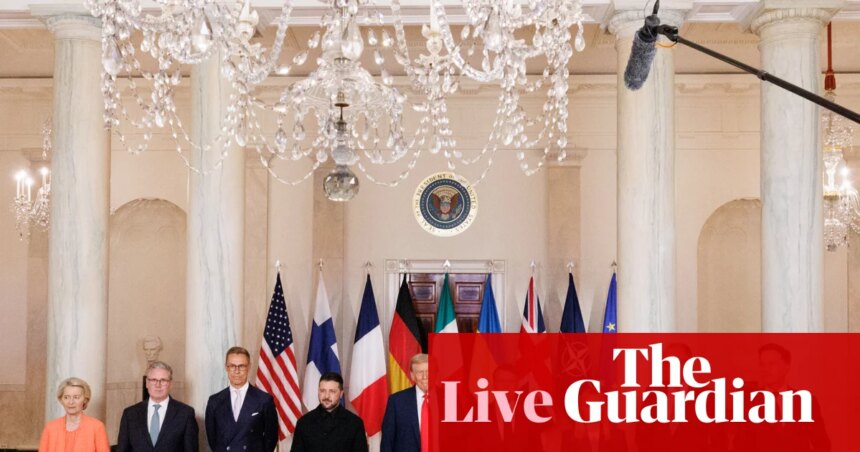
In a recent interview with Politico, former President Donald Trump launched a scathing critique of European leaders and the European Union, branding the continent a “decaying” group of nations governed by “weak” individuals. His comments come amid heightened concerns regarding migration policies and ongoing challenges related to the conflict in Ukraine.
Trump did not mince words when discussing the state of European leadership, stating, “I think they are weak,” and expressing skepticism about their ability to handle pressing issues. He specifically highlighted the consequences of what he described as politically correct policies that inhibit decisive action on immigration. “I think they don’t know what to do. Europe doesn’t know what to do,” he remarked.
He commended countries like Hungary and Poland for their stringent migration controls, contrasting them with what he sees as the lax policies of many other European nations. Trump asserted that Europe’s open-door policies are allowing unchecked and unvetted migration, a situation he believes poses a severe risk to the continent’s future.
Despite pushback from European leaders, Trump signaled his willingness to support domestic electoral candidates across Europe, including Hungarian Prime Minister Viktor Orbán, whose hardline immigration stance he praised. He argued that Europe as a whole is deteriorating due to its inability to manage migration effectively, warning that this could lead to a “much weaker” Europe driven by ideologically diverse newcomers.
His harsh assessment didn’t stop at migration; he criticized London’s mayor, Sadiq Khan, calling him “a disaster” and lamenting the changes he has observed in London and Paris, which he claimed are losing their historical identities and safety.
In discussing the ongoing war in Ukraine, Trump expressed skepticism about Europe’s role in peace negotiations. He suggested that European leaders excel at discussion but ultimately fail to produce tangible results. “They talk too much, but they don’t produce,” he said, adding that their inaction prolongs the conflict.
Trump further emphasized that the dynamics of power are shifting in favor of Russia in the context of the Ukraine war, claiming that “there can be no question” about Russia’s stronger negotiating position. He implied that Ukrainian President Volodymyr Zelenskyy must adapt to the realities on the ground and accept difficult decisions, stating, “he’s going to have to get on the ball.”
The former president’s comments are likely to strain relations further between U.S. and European leadership, particularly against the backdrop of ongoing diplomatic efforts to support Ukraine. Observers noted that while Trump’s criticisms aren’t new, reiterating them could complicate already delicate ties as Europe seeks to solidify its stance against Russian aggression.
As the situation unfolds, European leaders may find themselves having to navigate an increasingly complex relationship with the United States, especially when their stability and security are interconnected through shared geopolitical interests.