The U.S. stock market has demonstrated notable performance in 2025, with the S&P 500 up 16% this year, despite lingering economic uncertainties prompted by President Trump’s tariff policies. However, concerns are emerging regarding the sustainability of this growth as the S&P 500 currently trades at one of its highest valuations in four decades, with potential implications for future market performance.
A recent study by the Federal Reserve Bank of San Francisco presents a stark contrast to the president’s view, which posits that tariffs would bolster the U.S. economy. The research, which scrutinized 150 years of data from both the United States and abroad, indicates that tariffs could lead to higher unemployment rates and a deceleration in GDP growth. According to the Budget Lab at Yale, tariffs are projected to reduce GDP growth by half a percentage point in 2025 and 2026.
The implications of reduced GDP growth are significant, especially considering the correlation between GDP and corporate earnings growth, which ultimately affects stock market performance. Historical data reveals that from 2005 to 2014, a 43% increase in nominal U.S. GDP corresponded with a total return of 110% for the S&P 500. In a more robust economic period from 2015 to 2024, a 67% rise in GDP was associated with a remarkable total return of 243% for the index.
Currently, the forward price-to-earnings (P/E) ratio for the S&P 500 stands at 22.4, surpassing both the five-year average of 20 and the ten-year average of 18.7. This valuation is concerning as the index has historically crossed the 22 mark only during two notable periods in the past 40 years—during the dot-com bubble and the COVID-19 pandemic. Both instances were followed by significant declines in the index, with the dot-com bust resulting in a 49% drop and the pandemic causing a 25% decline.
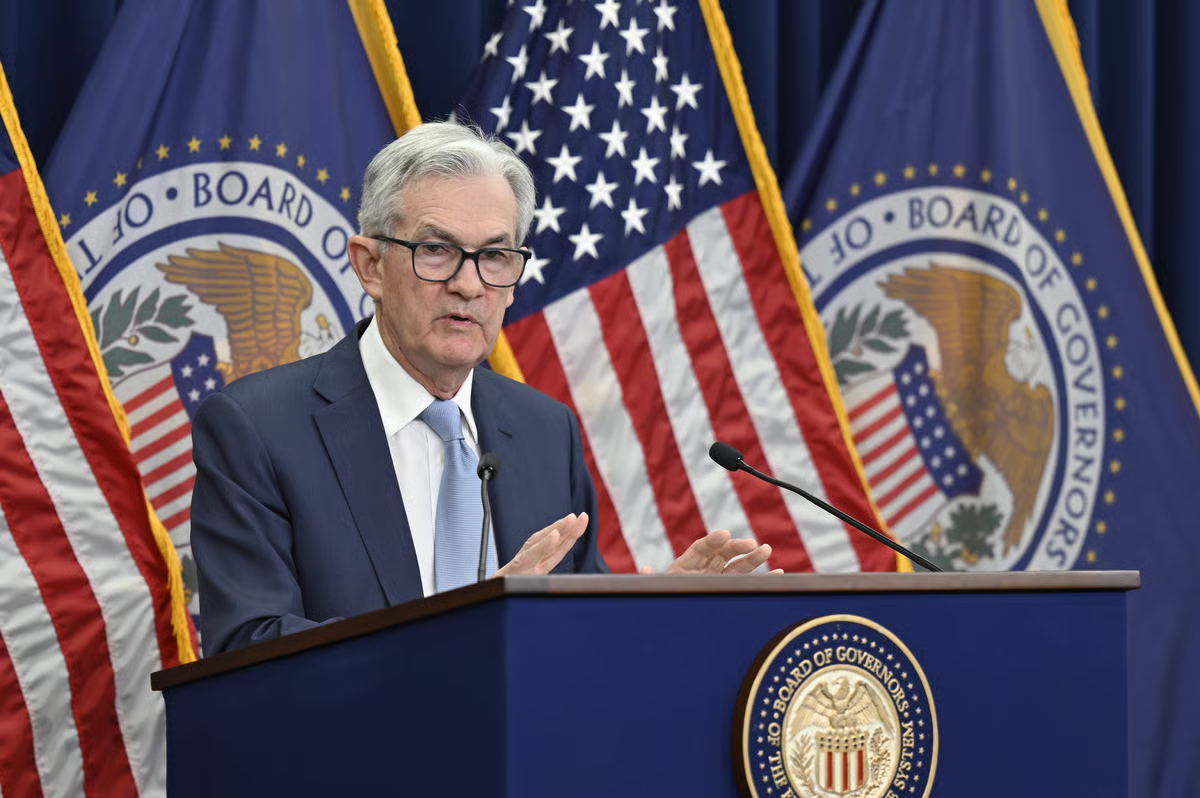
While the Federal Reserve refrains from making official judgments about asset valuations, Fed Chair Jerome Powell recently highlighted the elevated nature of equity prices, noting that they might be “fairly highly valued” based on various measures.
Although valuation metrics depend on future earnings estimates, caregivers in the financial sector are becoming cautious. For instance, initial estimates for S&P 500 earnings growth in 2025 predicted an 8.5% increase, but current projections indicate a rise of 13%. Despite this upward adjustment, the prevailing high valuation of the S&P 500 may make it susceptible to negative news regarding economic conditions, raising the risk of a market correction.
Given these indicators, investors are advised to reevaluate their portfolios, particularly for stocks in which they possess less confidence. This may also be an opportune moment to build cash reserves as a buffer against potential market volatility ahead.