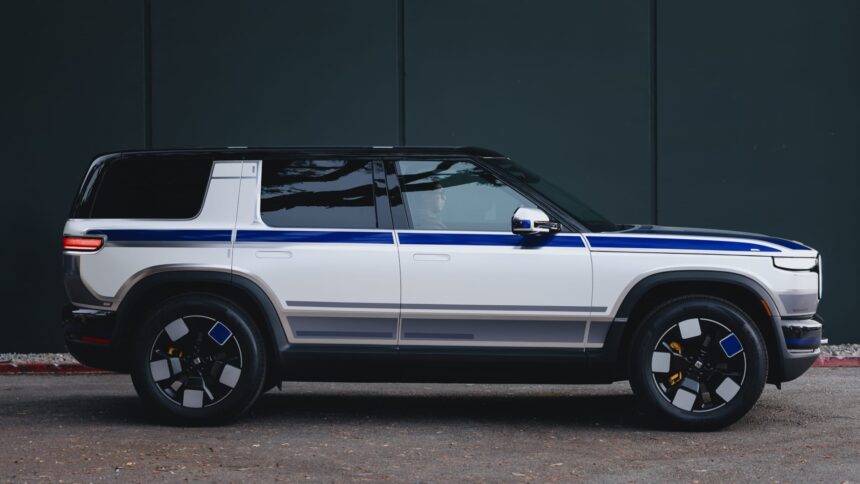
Electric vehicle manufacturer Rivian Automotive unveiled groundbreaking technologies at its inaugural “Autonomy and AI Day” held on Thursday in Palo Alto, California. The company showcased a custom chip, a new car computer, and advanced artificial intelligence models specifically designed to facilitate self-driving capabilities in its upcoming vehicles.
A significant announcement during the event was Rivian’s plan to introduce an Autonomy+ subscription service in early 2026. This feature aims to deliver “continuously expanding capabilities” and will be powered by the Rivian Autonomy Processors and autonomy computers. The Autonomy+ service will be available for a one-time fee of $2,500 or at a monthly subscription rate of $49.99. This pricing strategy stands in contrast to Tesla’s premium Full Self-Driving (FSD) option, which is offered for $8,000 upfront or $99 per month.
Rivian also indicated that a software update is on the horizon, introducing a “Universal Hands-Free” mode that will provide Rivian vehicle owners with hands-free driving on over 3.5 million miles of North American roads, encompassing a significant portion of marked roads in the U.S.
Setting itself apart from Tesla, Rivian plans to incorporate lidar (light detection and ranging) technology and radar sensors in its forthcoming models to achieve “level 4” automation, as defined by the Society of Automotive Engineers (SAE). In practical terms, level 4 automation allows passengers to relax— even sleep— in the back seat as the vehicle navigates through various traffic and weather conditions. Notably, companies like Waymo, which is owned by Alphabet, already operate in the level 4 space with their robotaxi service.
During the event, Rivian CEO RJ Scaringe emphasized that while the company’s initial focus will be on personally owned vehicles, it is also eyeing opportunities in the rideshare market. “This enables us to pursue opportunities in the rideshare space,” he stated, highlighting how the development of self-driving technology could extend beyond individual ownership.
Rivian is joining other industry players like Tesla, General Motors, Honda, Lucid, and Nissan in the quest to deliver autonomous driving systems that meet level 4 standards, while also rolling out partially automated features to enhance driver comfort and safety.
Key to Rivian’s self-driving ambitions is the in-house development of a new chip set to launch in 2026. Vidya Rajagopalan, Rivian’s vice president of electrical hardware, explained that the chip utilizes “multi-chip module” packaging and boasts a high memory bandwidth crucial for artificial intelligence applications. With a remarkable bandwidth of 205 gigabytes per second, this chip is designed to power Rivian’s autonomous driving features.
Amid challenges from fluctuating sales of battery electric vehicles in the U.S. and increasing competition from Chinese manufacturers, Rivian finds itself under pressure to assure investors of its growth trajectory and expand its customer base. The domestic electric vehicle market has seen a decline following the suspension of a federal tax credit that previously incentivized U.S. buyers. In 2023, Rivian’s shares have seen an uptick of about 25%, although they are still down more than 80% compared to the company’s initial public offering in 2021, reflecting the arduous journey it faces in the evolving automotive landscape.