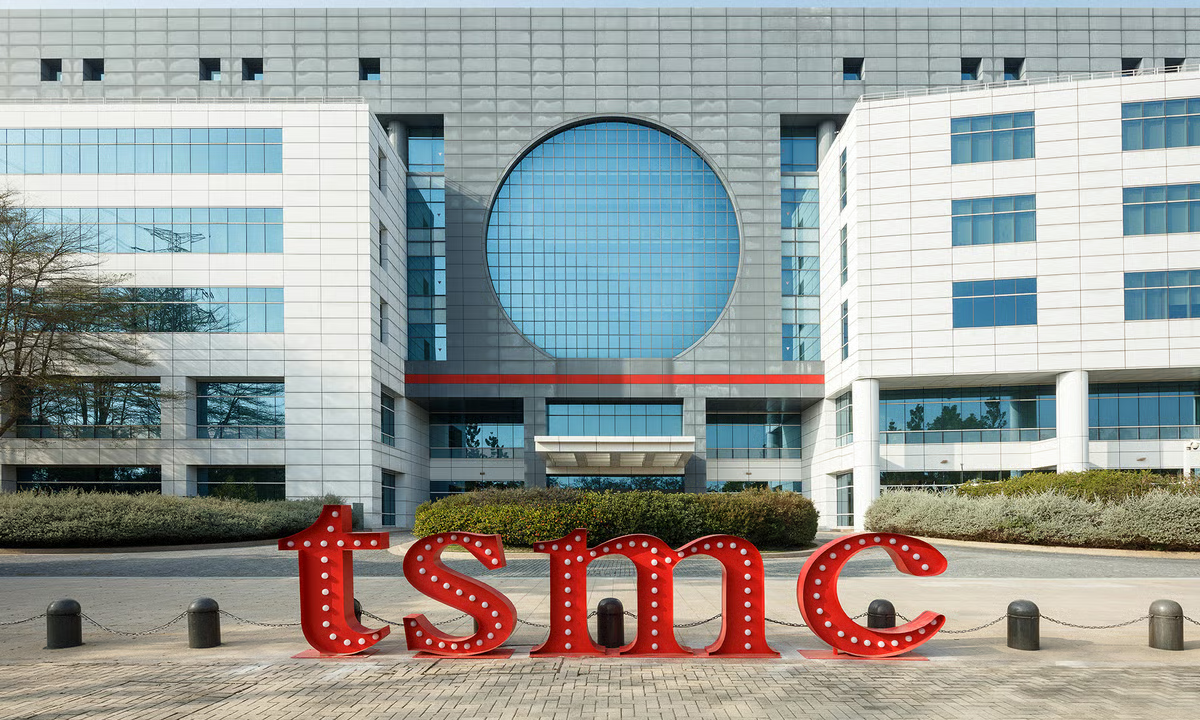
Taiwan Semiconductor Manufacturing (TSMC) is attracting significant attention as its stock appears set for robust gains in the upcoming year. The broader market has also been on an upward trajectory, with the S&P 500 enjoying a bull market that began in October 2022 and is anticipated to continue into 2026. After a remarkable run of three consecutive years with double-digit gains—an achievement only five times since the index’s inception in 1957—analysts are optimistic about further growth.
Deutsche Bank forecasts the S&P 500 could reach 8,000 points by the end of 2026, suggesting a potential increase of 15% from current levels. Furthermore, Ryan Detrick, chief market strategist at Carson Group, notes that bull markets lasting three years typically extend for an average of eight years, based on historical data since 1950. This trend bodes well for 2026, with artificial intelligence (AI) expected to be a significant growth driver this year.
JPMorgan highlights that capital spending and earnings growth, particularly due to AI, will catalyze stock performance in 2026. In this context, TSMC stands out as a pivotal player in AI adoption, making it an attractive investment opportunity before the market gains momentum.
As the world’s largest semiconductor foundry, TSMC manufactures chips for top-tier companies across various industries, leading to robust growth. As of the third quarter of 2025, TSMC commanded an impressive 72% of the foundry market, according to Counterpoint Research. Its advanced fabrication plants, which produce chips for giants like Nvidia, Qualcomm, and Apple, operate at full capacity.
The cutting-edge technology employed by TSMC allows it to maximize transistor density on its chips, resulting in powerful and energy-efficient products suited for data centers, smartphones, and personal computers. Deloitte projects that spending on AI data center chips could soar to between $250 billion and $300 billion this year, up from an estimated $150 billion last year, underlining the demand for TSMC’s manufacturing capabilities.
The overall semiconductor market is also set for expansion, expected to grow by 26% in 2026, reaching $975 billion. This growth is favorable for TSMC as it prepares to ramp up chip production to meet surging demand.
Goldman Sachs has raised its price target on TSMC stock by 35%, indicating confidence that AI will persist as a key driver of demand for fabrication services. Analysts suggest that the AI chip market could exceed $1 trillion by 2030, offering substantial long-term prospects for TSMC.
Looking ahead to 2026, consensus estimates predict a 25% increase in TSMC’s earnings, a decrease from the anticipated 48% growth in 2025. However, some analysts believe that TSMC could surpass these projections. The company’s margins are reportedly improving while it expands production capacity significantly.
TSMC’s capability in producing 2-nanometer (nm) chips may double by the close of 2026. Reports indicate that its current 2nm production capacity has already sold out. With plans to implement a premium pricing strategy for its 2nm nodes compared to 3nm, TSMC is well-positioned to achieve stronger earnings growth than analysts currently estimate.
Should TSMC replicate its previous year’s earnings growth in 2026, its share price could reach $15.43, based on last year’s estimated earnings of $10.43 per share. Currently trading at 26 times forward earnings—a lower valuation compared to the Nasdaq-100 index’s 33 times—there is potential for TSMC to align its valuation with industry averages if it performs better than expected. If these conditions are met, the stock could surge to approximately $509, a potential increase of 58% from current levels.
Investors are encouraged to consider adding this semiconductor giant to their portfolios, as advancing opportunities in AI could contribute to a significant appreciation in TSMC’s stock.