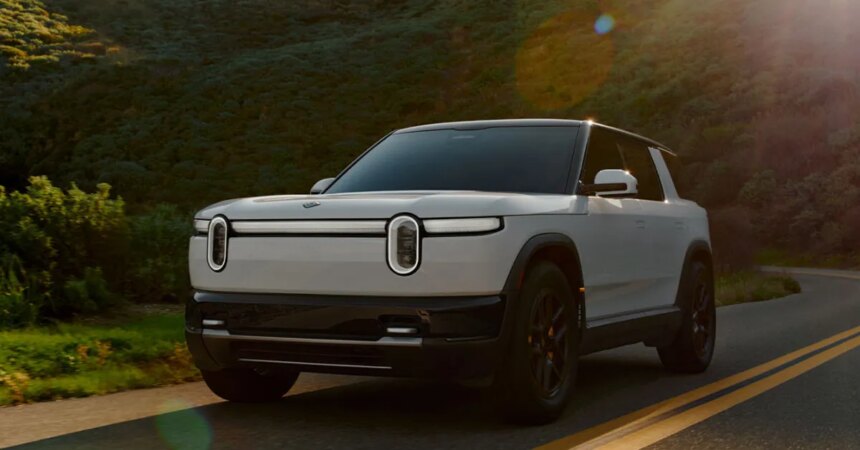
Rivian has announced an ambitious plan to ramp up production at its Georgia manufacturing plant, now projecting an annual output of up to 300,000 vehicles. This marks a significant 50% increase from its original production goal of 200,000 vehicles, aimed at bolstering support for its new midsize platform.
The announcement follows Rivian’s recent completion of a substantial expansion at its facility in Normal, Illinois, covering 1.1 million square feet. Last week, production of sellable R2 models commenced, signifying a pivotal development for the company.
Following the release of its first-quarter earnings report, Rivian revealed its strategy for the Georgia site. The new production capacity will not only enhance cost-efficiency but will also leave room for future expansions. An updated loan agreement with the Department of Energy is a crucial part of these changes; the loan, which could reach up to $4.5 billion, will align with the latest designs for Rivian’s facilities.
Construction is set to accelerate this spring, with the company anticipating to begin drawing on the loan by early 2027. Vehicle production at the Georgia plant is scheduled to start in late 2028, while preparations for the stamping press area, considered one of the priciest projects, are already underway. Rivian plans to expedite the construction progress during the summer as the prominent structures of the plant start to materialize.
CEO RJ Scaringe emphasized the transformative potential of the R2 platform, stating that it significantly broadens Rivian’s market opportunities. He highlighted the importance of the workforce that will be based in Georgia, noting their critical role in the company’s growth trajectory.
In addition to its manufacturing expansion, Rivian has forged a partnership with Uber to produce up to 50,000 robotaxis at the Georgia facility, slated to begin in late 2028.
In terms of recent performance, Rivian reported producing 10,236 vehicles and delivering 10,365 in the first quarter. The company is targeting total annual deliveries between 62,000 and 67,000 vehicles for the year. Financial results indicated a first-quarter revenue of $1.38 billion, reflecting an 11% increase compared to the same period in 2025. However, automotive revenue saw a slight decline to $908 million, attributed to fewer sales of regulatory credits and a higher composition of commercial vans affecting revenue per unit.
Rivian’s net loss for the quarter improved, decreasing to $416 million from the previous year’s $541 million, with a notable gain of $506 million in other income related to a Series A capital raise. The company ended the quarter with $4.8 billion in cash and equivalents, and with its credit facility included, total liquidity stood at $5.39 billion.