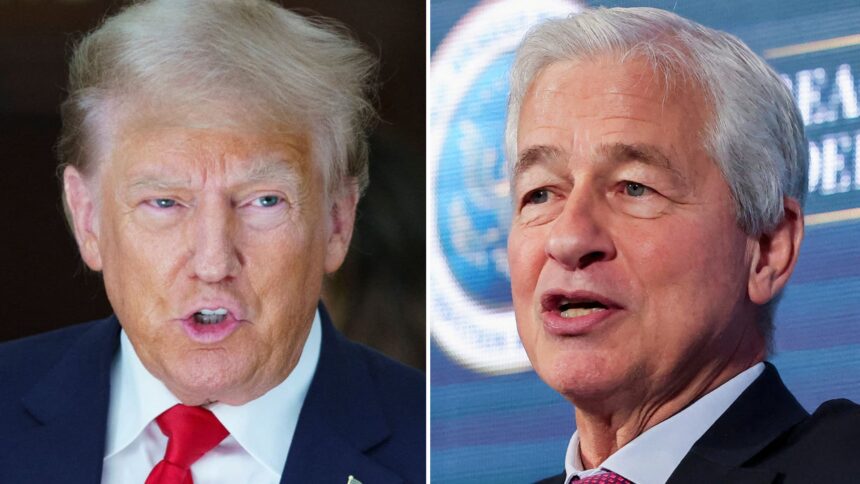
President Donald Trump has initiated legal proceedings against JPMorgan Chase and its CEO, Jamie Dimon, alleging that the bank closed his accounts, along with those of related entities, in early 2021 due to political motivations. This action followed the insurrection at the U.S. Capitol by Trump supporters on January 6, 2021, and coincided with Trump’s departure from the White House following the certification of Joe Biden’s electoral victory.
The lawsuit, filed in state court in Miami-Dade County, seeks at least $5 billion in civil damages. Trump, along with various business entities associated with him, contends that the bank’s decision was influenced by what they describe as “political and social motivations,” particularly JPMorgan’s purportedly “woke” ideology. The complaint argues that the bank made this decision based on a desire to distance itself from Trump and his conservative political stance.
“The lawsuit posits that JPMC’s unilateral closure of the plaintiffs’ accounts stemmed from a belief that the political climate favored such an action,” the filing states. Furthermore, the suit highlights a concerning trend among financial institutions in the U.S. that allegedly restrict access to banking services based on clients’ political ideologies that diverge from the institutions’ views.
Beyond the account closures, the complaint alleges that JPMorgan has created a blacklist, which purportedly includes Trump, the Trump Organization, and affiliated entities. This blacklist is claimed to be accessible to federally regulated banks and includes individuals and entities deemed non-compliant with banking regulations. The lawsuit asserts that the plaintiffs have always adhered to these banking rules.
In terms of legal claims, Trump and his fellow plaintiffs are alleging trade libel and a breach of the implied covenant of good faith and fair dealing against JPMorgan, as well as violations of Florida’s Unfair and Deceptive Trade Practices Act by Dimon.
In response, JPMorgan released a statement expressing regret over the lawsuit but maintained that it holds no merit. Spokeswoman Patricia Wexler emphasized that the bank does not close accounts for political or religious reasons but rather due to compliance with legal and regulatory risks. Wexler conveyed a desire for changes in banking regulations that could prevent such situations, supporting the notion that the banking system should not be weaponized for political ends.
As the legal proceedings unfold, this case raises broader questions about the intersection of banking practices and political affiliations, and how financial institutions navigate their roles in a highly charged political landscape.