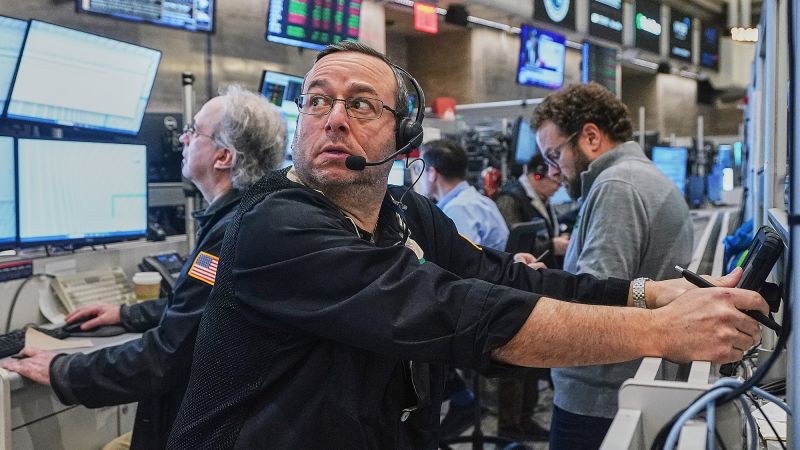
Markets were swept by a wave of nervousness Tuesday, with stocks declining sharply and bitcoin hitting a low unseen since late 2024. The Dow Jones Industrial Average fell by 167 points, or 0.34%, after experiencing a significant drop of up to 575 points earlier in the day. The S&P 500 and the tech-heavy Nasdaq Composite fared even worse, with losses of 0.84% and 1.43% respectively, marking their worst day in two weeks as technology and software sectors led the downturn.
In a reflection of the cautious market sentiment, bitcoin experienced a remarkable dip, slumping nearly 7% to fall just below $73,000—its lowest level since the presidential election victory of Donald Trump. Although it later rebounded slightly, trading around $76,800, the cryptocurrency remains down about 40% from its all-time high of over $126,000 reached in October. Despite earlier promises from the Trump administration to position the U.S. as the “crypto capital of the world,” bitcoin’s value has struggled to recover amidst ongoing market turbulence.
While stocks and bitcoin fell, precious metals saw a significant uptick. Gold futures rose by 6.7%, trading at $4,965 per troy ounce, while silver futures soared by 10% to approximately $85 per troy ounce. Gold’s rise is attributed to its status as a safe haven asset during periods of economic uncertainty, outpacing bitcoin in performance over the past five years. Gerry O’Shea, head of global market insights at Hashdex, noted that the recent trends indicate a growing investor preference for gold as a store of value amid geopolitical tensions and economic volatility.
Investor sentiment also took a hit from developments in the artificial intelligence sector. AI startup Anthropic announced new advancements for its Claude chatbot, including functionalities that could disrupt existing legal services. This news stoked fears regarding the impact of AI on software companies reliant on data services, leading to a pronounced sell-off in tech stocks. Salesforce shares plummeted by 6.85%.
As investors reassess their positions, a rotation within the tech sector is underway. Daniel Skelly from Morgan Stanley highlighted that investors are moving away from software stocks, turning instead to other momentum-driven sectors, such as memory technology.
The Nasdaq index, having reached a record high in October, is now down 3.18% from that peak. Similarly, the Dow is less than 1% from its all-time high, achieved in January. Major tech players like Microsoft and Amazon reported declines of 2.87% and 1.79%, respectively, while Nvidia, a front-runner in AI investment, also fell by 2.84%. Ongoing skepticism regarding the sustainable profitability of AI ventures and concerns over rising operational costs have kept investors on edge.
In the midst of corporate earnings season, scrutiny of company performance and spending forecasts has intensified. Walmart’s stock, however, rose by 2.94%, pushing its market value above the $1 trillion mark for the first time.
Market volatility escalated further following news that the U.S. military had intercepted an Iranian drone approaching a naval carrier. This exacerbated concerns of rising geopolitical tensions. The Chicago Board Options Exchange’s volatility index (VIX) increased by 10%, indicating heightened market fear. Oil futures also responded to these developments, with Brent crude gaining 1.6% and West Texas Intermediate climbing by 1.7%. Meanwhile, the U.S. dollar index saw a slight decrease of 0.28%, following a strong rebound in previous days.