In a recent report from Japan, the country’s economy showed slight growth, narrowly escaping the specter of a technical recession. The latest data indicates that Japan’s gross domestic product (GDP) grew by 0.1% in the fourth quarter of 2025 compared to the previous three months. This marks a rebound from a previous contraction of 0.7% in the third quarter, albeit falling short of economists’ expectations for a 0.4% expansion, as surveyed by Reuters.
The definition of a technical recession typically involves two successive quarters of negative growth, which Japan managed to sidestep. On an annualized basis, the fourth-quarter output increased by 0.2%, significantly lower than the predicted 1.6% and following a notable decline of 2.3% in the preceding quarter. Year-on-year comparisons reveal a modest GDP growth of 0.1% in the fourth quarter, a decline from 0.6% observed in the third quarter. The primary driver behind this slight expansion appears to be private consumption, which helped counterbalance weaknesses in both exports and public spending, according to data released by Japan’s Cabinet Office.
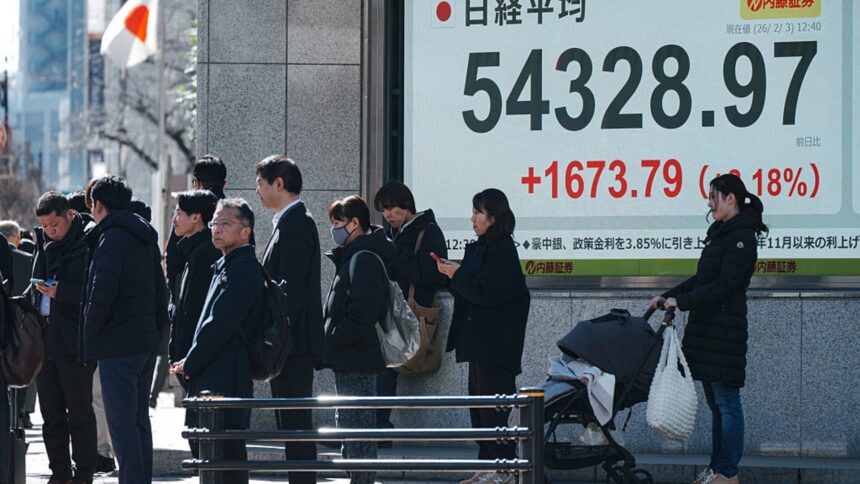
Subsequently, the Nikkei 225 index opened slightly higher, registering a gain of 0.12%. However, the Japanese yen depreciated by 0.25%, trading at 153.06 against the dollar. Earlier this month, the Bank of Japan upgraded its growth forecast for the fiscal year ending in March 2026 from 0.7% to 0.9%. Additionally, the central bank raised its outlook for fiscal 2026 to 1% from 0.7%, citing expected moderate economic expansion as other countries begin to recover.
This positive shift in outlook comes amid ongoing collaboration between Japan and the United States, which is Japan’s second-largest trading partner, as they work together on a substantial $550 billion investment commitment linked to their trade agreement. Reports from public broadcaster NHK suggest that Tokyo and Washington have yet to finalize the initial projects associated with this investment. Japan’s Economy Minister, Ryosei Akazawa, expressed hopes for the swift completion of these projects ahead of Prime Minister Sanae Takaichi’s anticipated meeting with U.S. President Donald Trump.
Following her resounding victory in the Lower House election on February 8, Takaichi emphasized her commitment to economic growth through an assertive fiscal policy, although specifics were not disclosed. She previously campaigned on suspending food taxes for two years and increasing defense spending to 2% of Japan’s GDP.
Bruce Kirk, Chief Japan Equity Strategist and managing director at Goldman Sachs, noted that defense spending is likely to serve as a significant catalyst for boosting Japanese equities. Speaking on CNBC’s “Squawk Box Asia,” Kirk mentioned his expectations for a “flurry of announcements” involving collaboration between Japanese and U.S. firms, especially in sectors such as industrialization, factory automation, and shipbuilding. He referenced a recent document from the Trump administration advocating for the restoration of U.S. maritime dominance and promoting cooperation with Japan and South Korea in revitalizing the shipbuilding industry.
Before the election, Takaichi had unveiled a record budget of 122 trillion yen for the fiscal year starting April 1, marking the second consecutive year of notable spending increases aimed at alleviating cost-of-living pressures for households. While Japan’s inflation rate settled at 2.1% in January, its most modest level since March 2022, it has remained above the Bank of Japan’s 2% target for over 45 consecutive months.