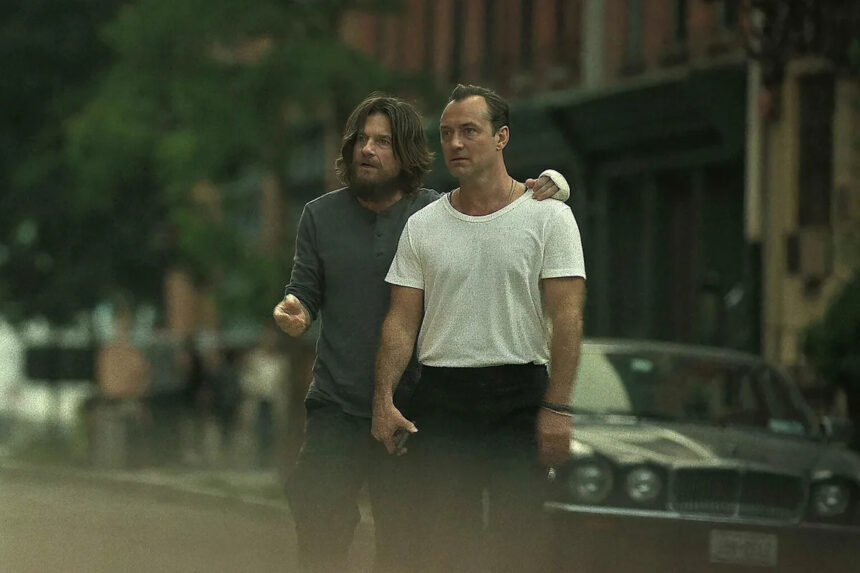
In the new Netflix series “Black Rabbit,” created by Zach Baylin and Kate Susman, Jason Bateman and Jude Law portray brothers whose complex relationship is set against the backdrop of their gritty upbringing. Sons of a Coney Island bar owner, Jake and Vince Friedken have turned their troubled childhood spent in local dives into managing a trendy restaurant in downtown New York City. However, the stark contrasts between the siblings add tension to their partnership: Jake (Law) is a high-energy hustler, always skirting the edge of financial stability, while Vince (Bateman) is a former addict who cannot shake his inclination for risky schemes.
The show dives into the brothers’ access to a fortune built on the principle of “fake it till you make it.” Memories from their childhood reveal a father who attempted to buy their silence with phony gold watches, telling them, “They’re as real as you tell people they are.” This theme of pretense runs through “Black Rabbit,” which is a gritty crime drama that struggles to balance its street-smart aspirations with a glossy presentation. The brothers’ last name, Friedken, seems to nod to esteemed director William Friedkin, known for his raw urban thrillers.
The titular restaurant isn’t Jake’s first foray into the spotlight. In the ’90s, he and Vince had a band called the Black Rabbits, which produced a karaoke hit but dropped off the music scene due to Vince’s impulsive decision to offend their label head. Now nearing 50, Jake is haunted by the swift passage of time and the fleeting nature of success, even as he tries to project confidence in his restaurant venture. Vince, on the other hand, brings a frantic energy, which leads him back to New York from a failed business endeavor in Las Vegas.
As Vince returns, he brings a whirlwind of chaos, exacerbating Jake’s struggles with an estranged financial backer, Wes, who has been a crucial part of the restaurant’s success despite his extravagant expenses. Reflecting on their familial dynamics, the show employs flashbacks, including one where Vince pitches the idea of their restaurant as “a port in a storm.” However, Vince is more of a storm than a shelter, a characterization reinforced by the description “Hurricane Vince.”
The series draws attention to the parallels between the brothers’ traits, emphasizing their shared addictive personalities. Despite the grim atmosphere and heavy themes, Bateman manages to capture a strangely likable, dirtbag charm, whether sprinting through Chinatown looking disheveled or revisiting the hilarity of their band’s past. However, the series’ extended runtime of eight-plus hours often leads to a repetitive intensity, diminishing its initial impact and leaving viewers yearning for a more varied narrative experience.
While “Black Rabbit” offers glimpses of a more light-hearted tone, especially with nostalgic references, the show does little to diversify its narrative tone, often feeling oppressively heavy. It repeatedly signals its earnestness but struggles to deliver on its ambitious promises. In a landscape filled with complex character studies, “Black Rabbit” reflects on the struggles of familial bonds and the illusion of success, but risks losing viewers in its sometimes monotonous approach.