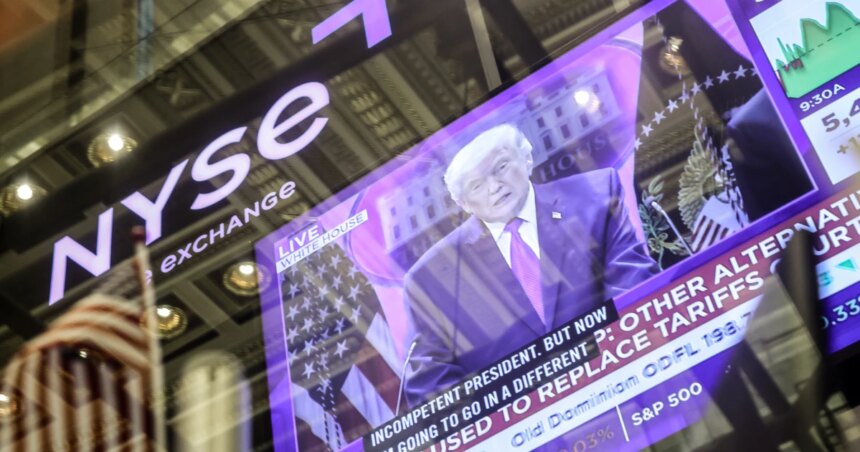
U.S. stocks saw a turbulent day of trading as the Supreme Court ruled against President Donald Trump’s ability to impose extensive tariffs under the International Emergency Economic Powers Act. Following the announcement, major indexes experienced a sharp increase, but this momentum was met with fluctuations throughout the day. By the market’s close, the tech-heavy Nasdaq composite index had gained nearly 1%, the S&P 500 added close to 0.7%, and the Dow Jones Industrial Average rose by 230 points, or 0.5%.
In addition to stock performance, U.S. Treasury bond yields surged across various maturities, with the yield on the 10-year bond, which closely tracks mortgage rates, climbing to 4.09%. The 30-year Treasury yield exceeded 4.74%. Initially, the U.S. dollar strengthened against other currencies, including the British pound, euro, and Japanese yen, but ended the day lower as investors processed the implications of the ruling. A stronger dollar typically indicates confidence in U.S. assets and economic stability.
Contrarily, gold and silver prices saw an uptick, reflecting ongoing investor concerns regarding tariff uncertainties. Stocks of companies with significant exposure to tariffs, such as retailers and appliance makers, emerged as some of the day’s top performers. Both Amazon and Apple recorded strong gains as leading Dow stocks, while logistics firms like Old Dominion Freight Line and Paccar also outperformed the broader market.
S&P 500 sectors focused on consumer discretionary, industrial, real estate, and technology stocks finished strong, overshadowing sectors more insulated from tariffs. Dan Ives, a managing director at Wedbush Securities, commented that the ruling by the Supreme Court was largely anticipated and represented a significant setback for the Trump tariff agenda. He noted that companies have already started adjusting their supply chains in response to the evolving tariff landscape.
Despite providing immediate clarity for U.S. companies, concerns linger regarding the administration’s potential search for alternative routes to impose import duties. Michael Pearce, chief U.S. economist at Oxford Economics, indicated that any short-term economic boost from lowered tariffs may be counterbalanced by protracted uncertainty. He cautioned that even if tariffs are renewed in some form, the implications could vary widely by sector and location, fostering additional trade policy uncertainty.
Evercore highlighted that the Supreme Court’s ruling did not address the process for refunding tariffs, anticipating a complex and extended resolution process. Ives suggested that if the ruling results in refunds, it could ultimately benefit the tech sector.
On the economic front, hours prior to the court’s decision, the Bureau of Economic Analysis released data showing U.S. real gross domestic product growth of 1.4% in the last quarter of 2025, a decline from the previous quarter’s 4.4%. Concurrently, President Trump’s approval ratings related to economic management dipped to 34%, according to a Reuters-Ipsos survey. As Trump prepares for his State of the Union address to a joint session of Congress next week, these economic challenges remain at the forefront of national discourse.