To President Donald Trump, the dollar is akin to a yo-yo, seemingly subject to his whims. However, for equity investors, the situation appears more precarious as they are grappling with a fluctuating dollar, which now presents a significant challenge in assessing stock valuations.
While a declining dollar isn’t entirely detrimental to the U.S. stock market—exporters can capitalize on increased demand, and multinational firms may enjoy higher revenues from overseas—there are considerable downsides. A weakened dollar can make American assets less appealing to foreign investors, which could curtail capital inflow and redirect funds to international markets. Furthermore, domestic manufacturers face higher costs for imports, risking inflation for products sold Stateside.
Despite these challenges, Trump remains unconcerned about the dollar’s recent decline—a statement that unnerved forex traders and prompted Treasury Secretary Scott Bessent to reaffirm Washington’s longstanding stance favoring a strong currency. Following the president’s comments, the dollar saw its most significant single-day increase since May; yet, it remains substantially lower than it was a year ago, sparking concern among equity traders.
Chris Zaccarelli, Chief Investment Officer at Northlight Asset Management, notes that a declining dollar is a “net negative” for U.S. equities. He anticipates that investors will pivot towards U.S. stocks that are export-oriented, citing a significant performance gap since the market’s low in April. A Barclays Plc composite of companies benefiting from a weaker dollar has surged by 70%, compared to a 39% increase in the S&P 500. In contrast, companies that prosper from a strong dollar have seen only modest gains.
The group benefiting from a weak dollar features firms like Lam Research Corp., Freeport-McMoRan Inc., and News Corp., all heavily reliant on foreign revenues. This category of stocks has risen by over 8% this month, coinciding with a 1.3% decline in Bloomberg’s dollar index. In contrast, stocks like Dollar General Corp. and Nucor Corp., which thrive in a strong dollar environment, face mounting pressures.
The weak dollar is also driving investors to reconsider allocations, favoring international equities where returns in local currencies have outpaced those of American indices. While the S&P 500 has seen a modest gain of 1.4% this year, the Stoxx Europe 600 is up 3.2%. When accounting for the dollar’s depreciation, U.S. indices look even less favorable: Europe’s benchmark has risen by 4.4%, while Japan and Brazil have registered gains of 7.2% and 17%, respectively.
This trend is reminiscent of last year when many international markets outperformed the S&P 500 both in local currencies and, significantly, when adjusted for dollar strength. The ongoing disparity encourages international investors to withdraw capital from U.S. equities, particularly if their American holdings are losing value in local terms.
Michael Rosen, President and Chief Investment Officer at Angeles Investment Advisors, asserts the preference for strengthening currencies, as dollar weakness may not be advantageous for all foreign markets, particularly those reliant on exports. Countries like Taiwan and South Korea, as well as parts of Europe, could see profit margins squeezed as their local-currency revenues decline.
Yet, a soft dollar provides a macroeconomic boost, as financing costs drop, supporting global and domestic financial conditions. Firms that rely on imports priced in dollars could benefit from lower costs, allowing them to stabilize or improve profit margins.
According to data, nearly 60% of sales for companies in the Stoxx 600 occur overseas, contrasting sharply with the 15% to 28% figure for their U.S., Chinese, and emerging market counterparts. Consequently, European investors are increasingly focusing on firms that operate locally—those less exposed to currency fluctuations.
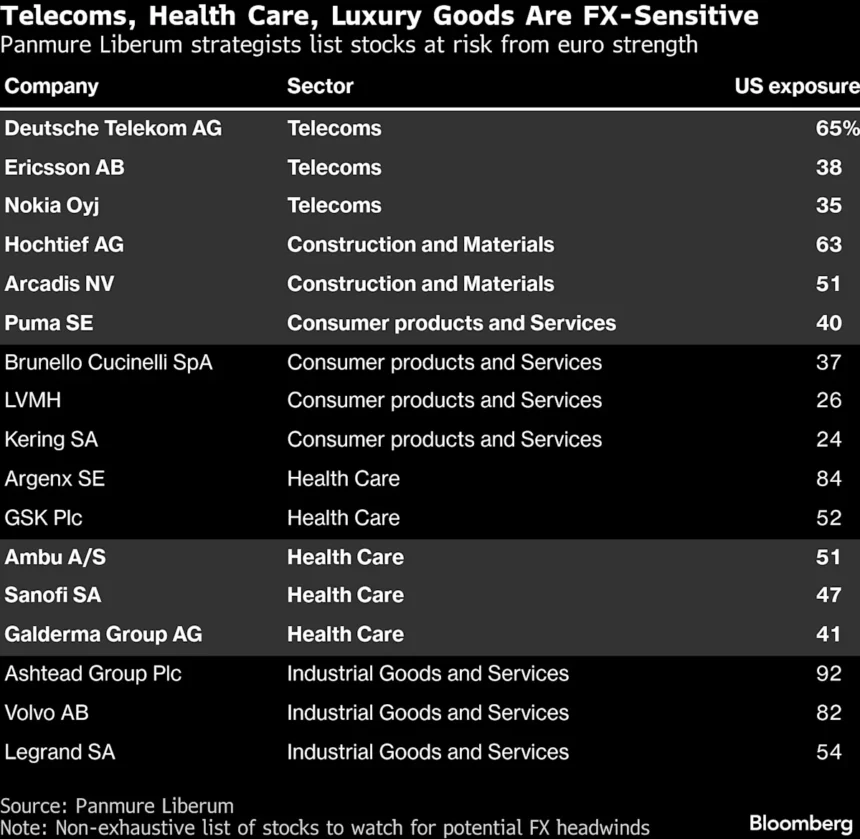
An analysis by Citigroup strategist suggests that a 10% rise in the euro against the dollar could lead to a roughly 2% decline in European earnings per share, particularly impacting commodity, food, beverage, health care, luxury goods, and automotive sectors.
While the weak dollar isn’t solely determinative of U.S. stock prices or corporate earnings, historical correlations indicate that only rapid shifts in dollar value have had significant impacts. The past 25 years reveal a meager correlation between dollar changes and annual earnings growth. Currently, traders may be on the cusp of a genuine sell-off, though a recent nomination by Trump for a Federal Reserve leadership position prompted a brief dollar rally.
In the backdrop of a near 10% decline in the Bloomberg Dollar Spot Index since Trump’s inauguration, it becomes evident that traders and investors are recalibrating their strategies amidst the ongoing volatility, as the administration’s focus appears to align with a weaker currency.