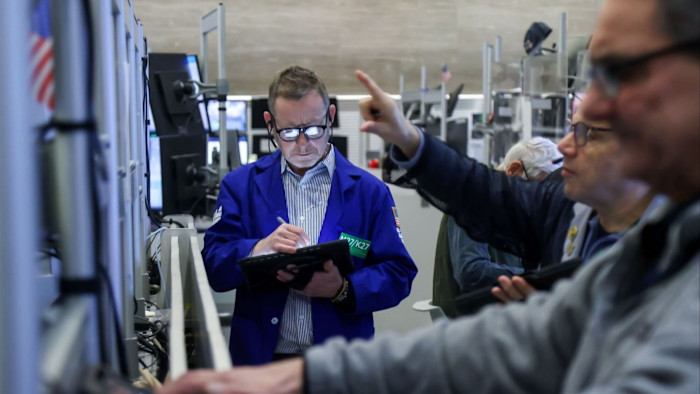
US technology stocks faced a significant downturn on Friday, heading toward their worst month in nearly a year. This decline has been influenced by investor concerns over the economic implications of artificial intelligence (AI) disruption and escalating tensions surrounding the US-Iran conflict. During morning trading, the Nasdaq Composite index fell 0.8%, amassing nearly a 3.5% loss for February, while also potentially marking its worst weekly performance since March 2025. The S&P 500 also dipped by 0.6%.
This month’s stock market turbulence can be traced back to fears that AI could drastically transform or even eliminate jobs in various sectors, including software, insurance, and wealth management. Analysts at Bank of America attributed the sell-off to a prevailing narrative suggesting that AI will drastically impact white-collar jobs, ultimately leading to economic collapse. They noted, however, that this narrative contradicts sound economic theories and that “crowded positioning” among investors has amplified market volatility.
Adding to the unease in financial markets, fears of a possible US military action against Iran have unsettled investors further, leading to a rise in oil prices. The international benchmark Brent crude rose by 2.8% to reach $72.70 per barrel. The US government’s decision to allow non-emergency staff in Israel to leave has fueled speculation about a potential military engagement, which some analysts believe has contributed to rising oil prices and heightened regional conflict concerns. Following this, significant military mobilization by the US, the largest since the 2003 Iraq War, has intensified apprehensions.
Tech stocks are facing ongoing scrutiny over the level of corporate spending required for AI infrastructure, with skepticism surrounding when such investments will yield returns. Despite Nvidia reporting robust revenues and profits earlier this week, the news failed to reassure the jittery market, resulting in a more than 2% decline in the chipmaker’s share price on Friday — a continuation of a 5.5% drop the previous day.
In the software sector, stocks experienced a similar fate, with worries about how new AI technology could disrupt existing business models. Workday’s shares plummeted by over 6%, pushing its losses for the year close to 40%. Similarly, private equity firms heavily invested in software companies also witnessed declines. A credit fund managed by KKR disclosed a concerning rise in troubled loans and reduced investment income, further stoking investors’ anxieties about the health of private markets.
Consequently, major private capital firms like KKR, Ares, and Apollo reported losses over 5%, while Blackstone’s stock fell by 3.3%. In search of safer investments, US government bonds saw a rally, pushing the yield on the benchmark 10-year Treasury down by 0.04 percentage points to 3.98%, dipping below 4% for the first time since November. This rise in bond prices has been attributed to increased demand for safe assets amid market uncertainties.
Friday’s market movements continued to reflect broader trends in the Treasury market, which is on course for its best month in a year, despite indications of persistent inflation. The shift toward government bonds has largely been driven by concerns regarding private credit and potential job displacement due to AI advancements.
Economic data released on Friday corroborated rising sentiments of market pessimism, showing a larger-than-expected increase in producer prices. The Bureau of Labor Statistics reported a 0.5% rise in the producer price index for final demand in January, outpacing the anticipated 0.3% increase. Furthermore, the core measure, which omits fluctuations in food and energy prices, significantly rose by 0.8%, compared to projections of a 0.3% increase.
Market analysts, including Altaf Kassam of State Street Investment Management, described the producer price index (PPI) data as a confirmation of the market’s negative sentiment, indicating ongoing rate uncertainty at a time when investors were beginning to feel hopeful about easing inflation coupled with a softening job market.