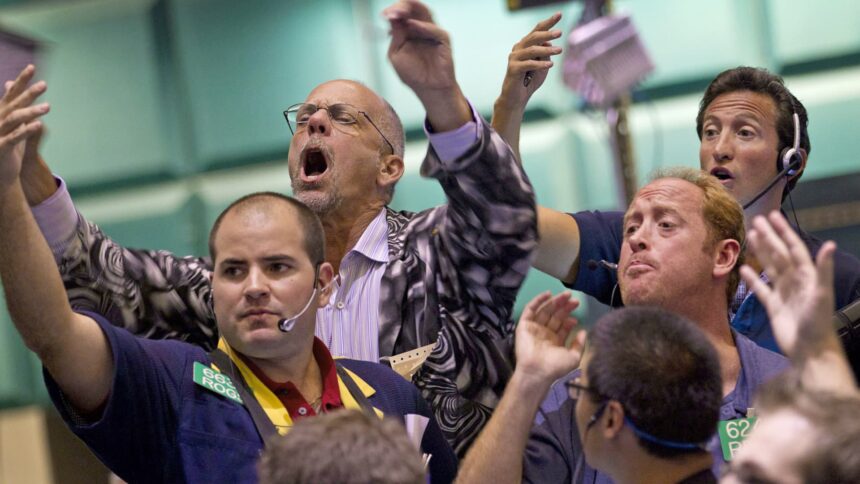
On Tuesday, markets displayed mixed results ahead of the Federal Reserve’s anticipated interest rate decision. Investors are largely expecting a quarter-point cut, fueling hopes that stock markets might rally towards record highs. The S&P 500 fluctuated but ultimately closed slightly lower, remaining just over 1% from its record high set on October 29. The Dow Jones Industrial Average faced a decline of 180 points, landing approximately 1.8% below its peak from November 12, while the Nasdaq composite managed a minor gain, reflecting a 0.9% rise for the month of December and hovering about 1.9% off its October high. In contrast, the small-cap Russell 2000 reached record levels, up 13% year-to-date. Notably, the yield on 10-year Treasury bonds increased, adding nearly 20 basis points since the beginning of the month.
In corporate earnings, software giant Oracle is set to reveal its quarterly results after the market closes on Wednesday. Following a stellar previous quarter that saw Oracle’s shares surge by 36%, the company has since witnessed a substantial drop of 36% from that high, erasing roughly $300 billion in market capitalization. Adobe is also scheduled to announce its earnings on Wednesday night, coping with a 2.8% decline over the past three months. For Synopsys, shares have plummeted 23% since its last earnings report.
In tech news, Nvidia finds itself impacted by external pressures, specifically concerning its AI chips in China. Reports indicate that the Chinese government intends to restrict the volume of H200 AI chips Nvidia can export, despite support from the Trump administration. Nvidia’s stock saw a dip after previously climbing over 2% in after-hours trading on Monday, marking a 13% decline from its October 29 record high. On Tuesday, Chinese stocks faced downturns, with notable ETFs such as the KraneShares CSI China Internet ETF falling 1.3% and the iShares MSCI China ETF slipping by 1.4%.
In financial markets, JPMorgan Chase’s stock fell sharply after a company executive conveyed concerns about a “more fragile” consumer environment, coupled with higher-than-anticipated expense forecasts for 2026. By the end of Tuesday, JPMorgan shares declined by over 4%, nearing a 7% decrease from its record highs in November. Executives from major financial firms, including Goldman Sachs and Bank of America, are scheduled to discuss findings and outlooks further at upcoming conferences.
In the consumer staples sector, Campbell’s earnings report revealed a decline in both sales and profit due to dwindling demand for snack foods, prompting a 5% drop in its stock. The company announced plans to acquire a 49% stake in Rao’s pasta sauce, but shares have decreased by 32% this year, contrasting the broader staples sector, which has seen only modest gains of about 1% over the same timeframe.
Investor days featured significant announcements from GE Vernova and CVS Health, with both companies projecting optimistic revenue forecasts and stock performance. GE Vernova’s shares rose in after-hours trading following commitments to increase its dividend and buyback plans. CVS Health’s shares also climbed over 2%, showcasing nearly a 75% increase year-to-date—its most favorable year since 1982. Meanwhile, Home Depot’s guidance fell short of expectations during its investor day, resulting in a 1% decline in its stock.
Amidst these developments, Exxon Mobil experienced a notable uptick of nearly 2% after projecting stronger earnings and cash flow growth through 2030, contributing to a 10% rise in its stock so far this year. In commodity markets, silver reached its 10th record high in 2023, soaring over 4% to settle at more than $60 per ounce—boasting a staggering 108% increase for the year. This surge prompted gains among silver miners, with many reaching 52-week highs. In contrast, gold also marked a solid year, rising 60% and solidifying its place as a strong performer in the commodities market.