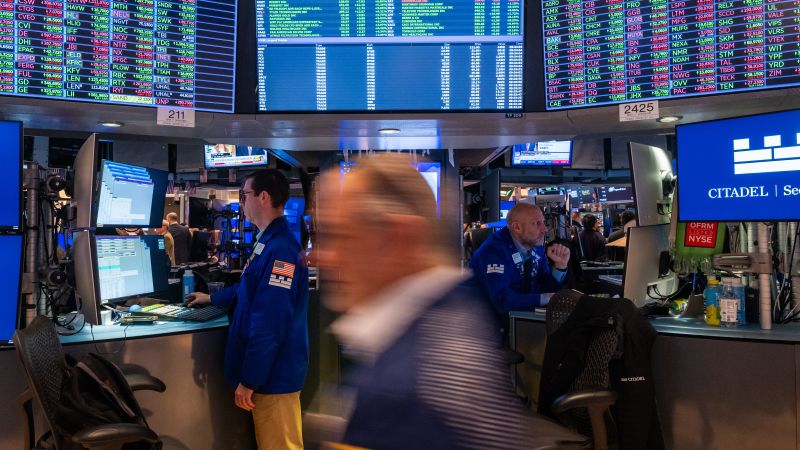
In recent months, technology stocks have struggled to maintain their previous momentum, raising concerns among investors about the overall health of the market. The tech-heavy Nasdaq Composite, which has historically driven market growth, has not seen a record high in the last four months, while both the S&P 500 and Nasdaq experienced their worst monthly performance since March.
The current market environment has highlighted a significant divide, with stocks less reliant on technology rising, particularly evident in the blue-chip Dow Jones Industrial Average, which is up 1.9% this year. In contrast, the S&P 500 and Nasdaq have seen more modest performances, with the former up only 0.49% and the latter down approximately 2.5%.
Market volatility is particularly pronounced in the face of growing concerns surrounding artificial intelligence (AI) and its impact on traditional business models. Nvidia, a leader in the AI sector, surprised the market with strong quarterly earnings yet nonetheless suffered its worst trading day since April. This serves as a reminder of the fragility in investor sentiment regarding tech stocks.
Analysts highlight that the immense investments made by big tech firms into data centers have led to skepticism over whether those expenditures will yield satisfactory returns. They advise investors to remain cautious, yet suggest that such market upheaval could create new opportunities.
Despite recent downward trends, long-term investors are encouraged to focus on the historical upward trajectory of major indexes like the S&P 500, which often smoothes out short-term fluctuations. As of Friday, U.S. stocks experienced a broad decline: the Dow dropped by 521 points (1.05%), the S&P 500 was down by 0.43%, and the Nasdaq slid 0.92%. The fear gauge on Wall Street, known as the VIX, rose by 8%, indicating increased anxiety in the market.
Additionally, the yield on the 10-year Treasury fell below 4%, reaching its lowest point since October as investors shifted their focus to bonds. Concurrently, oil prices surged over 2% amid ongoing geopolitical tensions between the United States and Iran.
With nearly 40% of the S&P 500’s value linked to major tech players like Nvidia, Microsoft, and Alphabet, some investors are reconsidering the balance of their portfolios. Experts caution that many may be unwittingly overexposed to tech. Jon Ulin from Ulin & Co Wealth Management emphasized the importance of not reacting impulsively to market noise while also undertaking portfolio reviews during turbulent times. He advocates reallocating investments to other sectors such as materials, energy, infrastructure, industrials, healthcare, and consumer staples.
Craig Johnson, chief market technician at Piper Sandler, recently downgraded his rating of the technology sector from “overweight” to “neutral,” reflecting a decision to lean less on technological investments. Instead, he remains optimistic about sectors like energy, which have shown resilience, suggesting that a broader market rotation may take place as investors seek refuge from volatility in tech.
So far this year, energy, materials, and consumer staples are leading the S&P 500, while sectors like tech and financials lag behind. A popular exchange-traded fund tracking energy has surged by 25%, contrasting sharply with a tech sector ETF that is down roughly 3.6%.
Uncertainty around AI remains palpable, with analysts divided on whether the worst is over. Investment strategies may depend on individual financial goals, but there are methods to navigate through heightened volatility. Portfolio manager Jed Ellerbroek from Argent Capital Management cautioned about rising fears regarding AI’s influence on the market and advocated for a well-diversified investment strategy.
Rebalancing portfolios, particularly through index options like the equal-weighted S&P 500—which minimizes the influence of major tech drops—could be a prudent approach, as it has outperformed the traditional S&P 500 thus far. Additionally, increasing exposure to international markets may further enhance returns, especially since European and Asian markets have demonstrated superior performance in 2025.
During these times of uncertainty, maintaining a focus on long-term investment strategies rather than getting swept up in daily market fluctuations is crucial. Wealth manager Johan Strand from Badgley Phelps emphasizes the importance of diversification and suggests that while market sentiment may be negative currently, he remains optimistic about the potential for a bullish year in 2026.