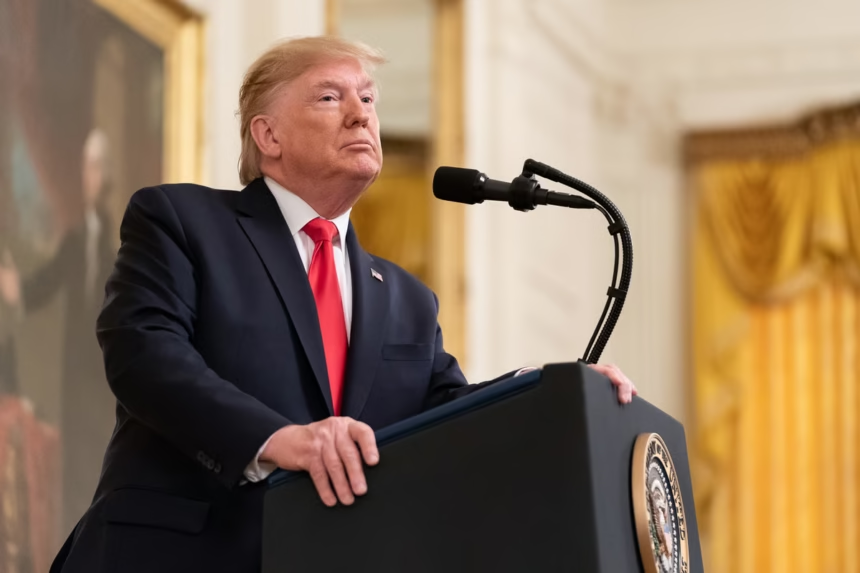
Stock market volatility has been a recurring theme during President Donald Trump’s time in office, yet the major indexes have shown remarkable gains. Over his first non-consecutive term, the Dow Jones Industrial Average, S&P 500, and Nasdaq Composite witnessed increases of 57%, 70%, and a staggering 142%, respectively. Continuing into his second term, which began on January 20, 2025, these indexes have posted additional gains of 14%, 15%, and 17% through February 20, 2026.
Despite the relative success of Wall Street under Trump, challenges are emerging that could pose significant risks to the market. Despite favorable factors such as declining interest rates, easing inflation, and stronger-than-expected corporate earnings, the potential for a stock market crash cannot be overlooked.
One key consideration is the historically high pricing of stocks. The Shiller Price-to-Earnings (P/E) Ratio, or CAPE Ratio, offers a long-term view of stock valuations, based on average inflation-adjusted earnings over the previous decade. Currently, this ratio is hovering between 39 and 41, representing the second-highest level in history. Historical patterns suggest that whenever this ratio exceeded 30—such as the previous instances leading up to major market downturns—a correction of 20% or more has often followed. This indicates that current valuations may be unsustainably high.
Additionally, the risk of an AI bubble bursting is looming on the horizon. The rise of AI has drawn significant investment, reminiscent of the internet boom in the late 1990s. However, just as businesses struggled to optimize internet-based strategies after its initial adoption, they may face similar challenges with AI. If investor expectations are not met, it could trigger a market downturn akin to past tech bubbles.
Furthermore, the Federal Reserve’s unprecedented divisions and dissenting opinions during recent meetings present another layer of uncertainty. The Fed’s core mission is to maintain maximum employment and price stability, but the recent lack of consensus among its members complicates its ability to reassure the markets. Divergence in opinions on whether to raise or lower interest rates reflects a broader uncertainty regarding monetary policy that could spook investors.
As Fed Chair Jerome Powell’s term approaches its end in May 2026, his rumored successor, Kevin Warsh, could introduce further volatility. Warsh’s inclination towards reducing the Fed’s substantial balance sheet has the potential to raise interest rates, a scenario that could be particularly unsettling for market participants.
With factors such as historically high stock valuations, the risk of an AI bubble, and internal conflicts at the Federal Reserve, the potential for a significant market correction exists—even amidst the current favorable economic indicators. Investors will need to remain vigilant as they navigate this complex landscape shaped by both opportunities and threats.