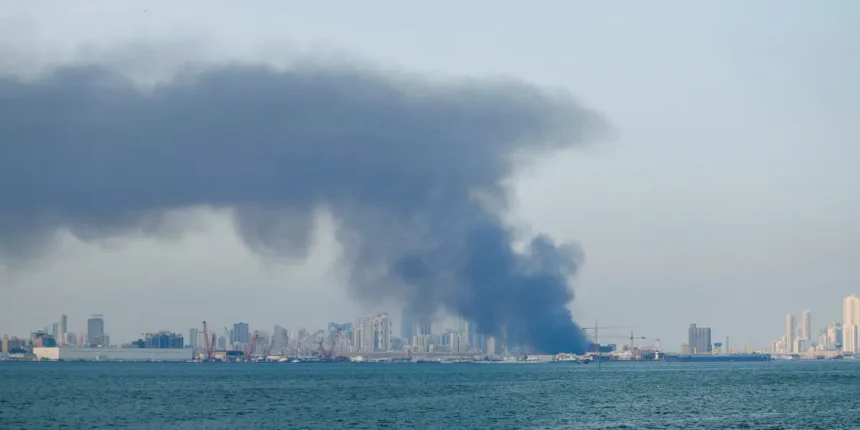
Markets are braced for volatility as the new week begins, with oil prices surging and US stock futures declining sharply following recent military actions against Iran by the US and Israel.
The international benchmark Brent crude oil saw a dramatic initial spike of 9%, while West Texas Intermediate (WTI) crude climbed 7% upon market opening. By 9:11 p.m. ET, these increases had stabilized somewhat, with Brent trading at $76.27 a barrel, reflecting a 4.7% rise, and WTI at $69.82, up by 4.2%. Energy traders are now focusing on the potential long-term closure of the Strait of Hormuz, a vital route for global energy shipments. Economist Mohamed El-Erian emphasized the immediate supply chain disruptions stemming from increased insurance costs and the impact on maritime cargo and aviation, underscoring the logistical challenges that have already emerged.
Analysts from Barclays described the situation as embodying the “worst fears” of the oil market, raising alarms about the risk of repricing across energy commodities. Notably, strategists at Franklin Templeton pointed out that Qatar’s significant liquefied natural gas (LNG) exports, which rely heavily on the secure passage through the Strait of Hormuz, could also drive a re-evaluation in gas markets, thus intertwining the fates of oil and gas prices. They termed the Strait of Hormuz as the “macro circuit breaker,” highlighting that global shipping costs have already seen an upward trend in the wake of the attacks.
The repercussions of skyrocketing oil prices could further fan inflation concerns, with historical precedents indicating that such spikes in energy costs might push the global economy toward recession. The future of US stock markets reflects this uncertainty, with futures for all three main indexes showing declines of over 0.6% as traders assess the likelihood of an extended conflict. Observations from market watchers suggest that the current sentiment reflects a relatively low probability of a protracted war affecting the region broadly.
Adam Hetts, global head of multi-asset at Janus Henderson, emphasized the need to monitor ongoing uncertainty, which could suppress investor confidence and shift preference toward safer asset classes, such as US Treasuries and stable currencies. He also cautioned that increased oil prices might complicate the Federal Reserve’s interest rate strategy, potentially diminishing the chances for cuts this year.
The precious metal market is reacting accordingly, with gold prices rising as much as 3.1%, now hovering around $5,410 per troy ounce. Analysts suggest that geopolitical tensions, particularly implications of conflict in the Middle East, could further enhance gold’s appeal as a safe haven.
Conversely, Bitcoin also experienced declines, trading around $66,239, reflecting a downturn alongside other risk assets. As for the US dollar, it strengthened, with the dollar index gaining 0.3%. Barclays analysts noted that the dollar’s initial response to the escalated tensions will likely be supportive due to higher energy prices and greater risk aversion among investors.
In Asian markets, equities took a hit as Japan’s Nikkei 225 slid by 2.7% and Hong Kong’s Hang Seng fell 2.8%. Chris Weston, head of research at Pepperstone, described the prevailing market sentiment as risk-off but not panicked, highlighting that while various asset classes did react to the geopolitical turbulence, the movements were relatively contained and orderly, mainly isolated to the energy sector.
Further complicating the landscape, Brent crude’s struggle to maintain levels above $80 indicates that investors might already be factoring in significant supply disruptions. Anticipated increases in output quotas from OPEC+ could also serve to temper the upward pressure on oil prices, as the group plans to boost production by 206,000 barrels per day starting in April.