In a significant response to escalating tensions in the Middle East, oil prices surged on Monday, while U.S. stocks clawed back from earlier losses and gold prices experienced a notable uptick. These developments highlight the growing concerns among investors regarding the potential for an expanded conflict involving Iran.
Market participants are currently navigating a landscape marked by heightened volatility in global energy markets. While there have been sharp price movements, the volatility aligns with prevailing expectations, prompting Wall Street to remain vigilant for potential further disruptions to oil and gas prices.
The recent spike in U.S.-Iran tensions has driven many investors toward safe-haven assets, with gold and the U.S. dollar seeing increased demand amidst the uncertainty. Global oil prices reached their highest levels in over eight months, with Brent crude, the international benchmark, climbing 6% to $77.20 per barrel, a peak not seen since U.S. military strikes on Iranian nuclear facilities in June. Concurrently, West Texas Intermediate crude, serving as the U.S. benchmark, rose 5.5% to $70.68 per barrel, also marking its highest level since the summer.
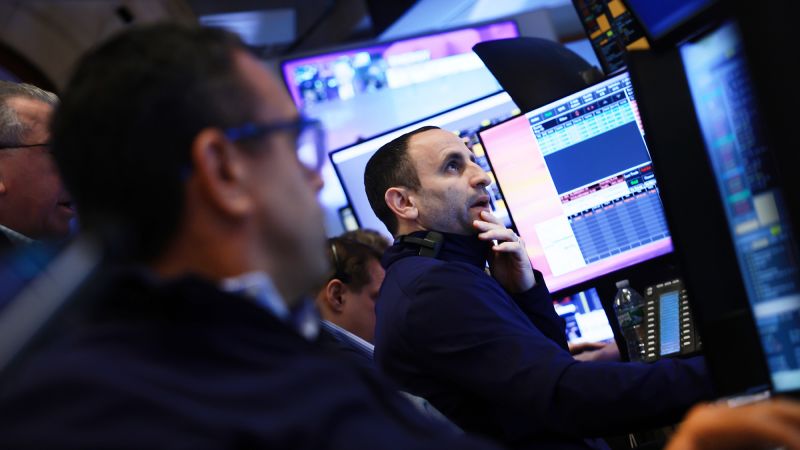
Although stocks worldwide experienced downward pressure, U.S. equities managed a slight uptick after significant early declines. The Dow Jones Industrial Average fell modestly by 30 points, recovering from a near 600-point drop earlier in the session. The S&P 500 and the tech-heavy Nasdaq both moved into positive territory, with increases of 0.1% and 0.5%, respectively. Conversely, Europe’s Stoxx 600 index declined by 1.6%, while Japan’s Nikkei 225 dropped 1.35%.
Market analysts suggest that Wall Street is betting on a brief yet turbulent conflict, noting historical trends where stocks tend to rebound shortly after geopolitical tensions ease. The future trajectory of oil prices will be crucial in determining the continued impact on stocks and the broader economy.
Despite surging oil prices, Wall Street is also grappling with persistent weaknesses in technology and artificial intelligence stocks, coupled with concerns about the health of the private credit market and elevated stock valuations. The market’s fear gauge, the VIX, rose by 6%, having experienced a significant spike of 25% earlier in the day.
In the energy sector, diesel prices soared, outpacing overall oil price increases and reaching a two-year high. Futures for European gasoil surged by 17%, while U.S. diesel futures rose by 13%. Natural gas futures in Europe experienced a dramatic 37% increase, driven by fears of further market disruptions precipitated by ongoing conflicts in the region. QatarEnergy announced a halt in liquefied natural gas production following an Iranian attack on its facilities.
Gold prices rose by 1.4%, reaching their highest level in a month, momentarily breaching $5,400 per troy ounce before settling. As a traditional haven asset, gold has faced significant price fluctuations recently but benefited from increased demand in light of geopolitical unrest.
Moreover, the U.S. dollar strengthened against other major currencies, driven by investors seeking safety. The U.S. dollar index climbed 1%, recovering its earlier losses for the year and hitting a five-week high. Continued uncertainty surrounding oil prices and U.S.-Iran relations could lead the Federal Reserve to maintain steady interest rates for an extended period, further supporting the dollar.
In the bond market, U.S. government bonds fell after initial gains, with Treasury yields reflecting this shift. The 10-year Treasury yield dipped to 3.96%, its lowest since November, before rising to 4.06%.
Cryptocurrency also showed signs of resilience, with Bitcoin gaining over 5% to reach $69,850, after initially declining.
While broader market indices faced downward pressure, certain sectors reacted more dramatically. Defense stocks saw significant increases, with Northrop Grumman, RTX Corporation, and Lockheed Martin experiencing gains of 3.75%, 4.4%, and 2%, respectively. Conversely, airline stocks encountered declines as uncertainty regarding the Middle East heightens, leading to drops in major U.S. airlines like American Airlines, Delta Air Lines, and United Airlines, as well as European carriers such as Air France and Lufthansa.
Overall, analysts suggest that markets are holding up better than might be expected in light of the geopolitical situation. Future fluctuations in oil prices and the duration of the conflict will be pivotal in shaping the economic landscape, with a scenario involving oil prices around $80 deemed manageable, while levels exceeding $100 could provoke substantial economic repercussions.