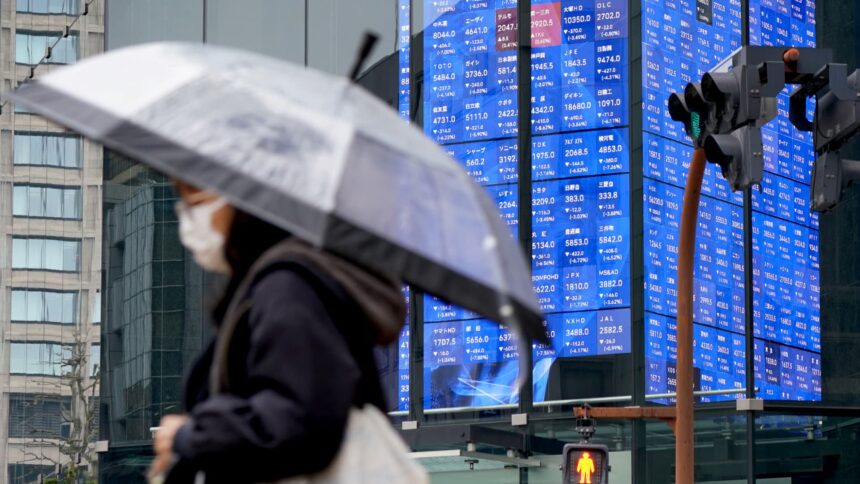
In a sharp turn of events for the Asian markets, South Korean stocks recorded significant losses on Friday, driven by a downturn in major technology companies and concerns from the previous day’s performance on Wall Street. The Kospi, South Korea’s primary stock index, fell by 4.11%, reflecting a challenging atmosphere as tech giants Samsung and SK Hynix saw their shares plummet by 6% and 8%, respectively. Meanwhile, the smaller-cap Kosdaq index experienced a decline of 2.41%.
Japan’s benchmark Nikkei 225 also faced pressure, dropping 1.1%. In Australia, the S&P/ASX 200 saw a more modest decline of 0.2%. The atmosphere on the Hang Seng index in Hong Kong was similarly tense, with futures trading at 25,158, slightly below Thursday’s closing figure of 25,253.40.
This regional downturn followed a mixed performance in the U.S. markets, where the Dow Jones Industrial Average set a new all-time high of 51,561.93, climbing 874.86 points or 1.73%. Conversely, the Nasdaq Composite struggled, nudging down by 0.09% to end at 26,830.96. The S&P 500 managed a modest gain, increasing by 0.41% to rest at 7,584.31. The divergence in performance underlined a notable shift in investor sentiment, as there appeared to be a rotation away from technology stocks and toward non-tech sectors.
This shift was catalyzed by a significant sell-off in Broadcom, which saw a decline of over 12% after the chipmaker fell short of revenue expectations for its fiscal second quarter. The decline in Broadcom rippled through the semiconductor sector, which had previously driven much of the market’s recent gains. The VanEck Semiconductor ETF (SMH) was also affected, losing over 1%, with other notable declines from companies like Arm Holdings and Micron Technology.
Further complicating the investment landscape, concerns pertaining to geopolitical tensions in the Middle East have created additional headwinds. Recent developments on this front have been mixed, leading to uncertainty that has unsettled global markets and resulted in rising oil and gasoline prices.
As traders and investors navigate this tumultuous environment, the contrasting performances between sectors hint at shifting priorities and a possible reassessment of risk in the current economic landscape.