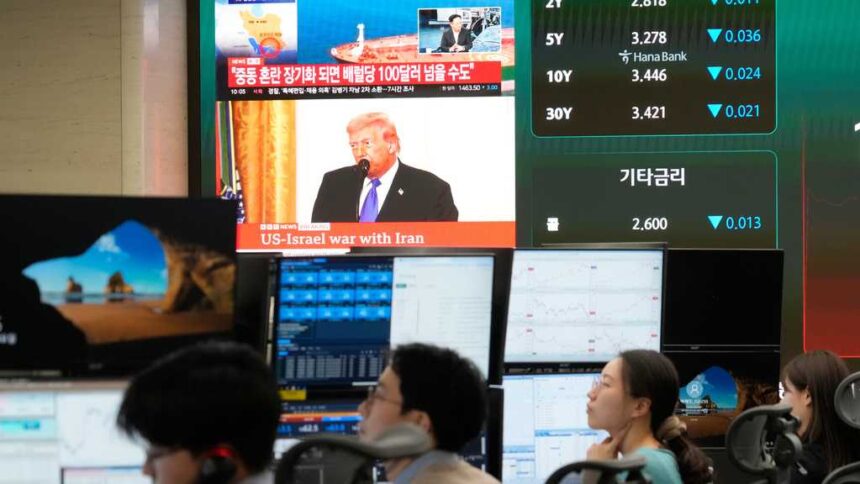
Asian markets faced a notable downturn on Tuesday, with most shares declining as investors grappled with the implications of the ongoing conflict in Iran on regional energy supplies. South Korea’s market bore the brunt, plummeting 4.8% to close at 5,946.06 following its re-opening after a holiday.
Oil prices surged significantly amid escalating tensions; benchmark U.S. crude oil rose by 77 cents to $72.00 a barrel, while international Brent crude climbed $1.10 to $78.84 a barrel. Although prices saw a temporary decline after their initial jump, concerns lingered that the ongoing conflict might disrupt global crude oil flows.
Japan’s Nikkei 225 index also experienced a sharp drop of 2.1%, settling at 56,853.48. Given Japan’s reliance on oil and natural gas imports through the Strait of Hormuz, the nation is particularly vulnerable to disruptions. Nevertheless, analysts indicated that Japan’s current oil stockpiles, which could last over 200 days, mitigate the immediate risk.
In Japan’s energy sector, stocks took a hit—with Eneos Corp. and Idemitsu Kosan seeing declines of nearly 6% and 4%, respectively. Defense-related stocks, which had previously surged on expectations of increased military spending by Prime Minister Sanae Takaichi, faltered as traders sought to secure profits, with Mitsubishi Heavy and IHI losing 5% and 4% respectively.
Across Asia, Australia’s S&P/ASX 200 index fell 1.2% to 9,089.50. In Hong Kong, the Hang Seng index dipped 0.1% to 26,038.29, while the Shanghai Composite index declined 0.3% to 4,170.63.
Airline stocks, already under pressure from rising fuel costs exacerbated by higher oil prices, suffered additional losses. Notably, ANA Holdings dropped 2.4%, Japan Airlines fell 5.2%, Korean Air saw an 8.9% decline, and Qantas Airways lost 2.9%. The ongoing tensions in the Middle East have led to airport closures, stranding numerous travelers.
Despite these regional declines, the response from U.S. markets has been relatively subdued. Historical data suggests that military conflicts in the Middle East have typically not led to prolonged downturns in U.S. stock indices. Analysts from Morgan Stanley observed that a sustained drop in U.S. stocks would likely require oil prices to exceed $100 per barrel.
Financial metrics indicated resilience in the U.S. markets; the S&P 500 initially fell by as much as 1.2% before recovering to close with a minimal gain of less than 0.1% at 6,881.62. The Dow Jones Industrial Average dipped slightly by 0.1% to 48,904.78, while the Nasdaq composite rose by 0.4% to 22,748.86, both bouncing back from earlier losses.
Gold prices increased by 1.2% as investors sought safer assets amid uncertainty surrounding the conflict. Furthermore, U.S. oil companies gained traction from the rising crude prices, with Exxon Mobil and Marathon Petroleum experiencing increases of 1.1% and 5.9%, respectively. Military equipment manufacturers also saw stock value increases, with Northrop Grumman climbing 5.9% and RTX gaining 4.7%. Big Tech also witnessed upward movement, with Nvidia rising 2.9%, contributing to the S&P 500’s rebound.
In the bond market, the yield on the 10-year Treasury note increased to 4.04% from 3.97%. A stronger manufacturing report for the U.S. helped bolster the yields. In currency exchange, the U.S. dollar slipped against the yen, trading at 157.32, down from 157.47. The euro saw a slight uptick, landing at $1.1693, compared to $1.1690 previously.