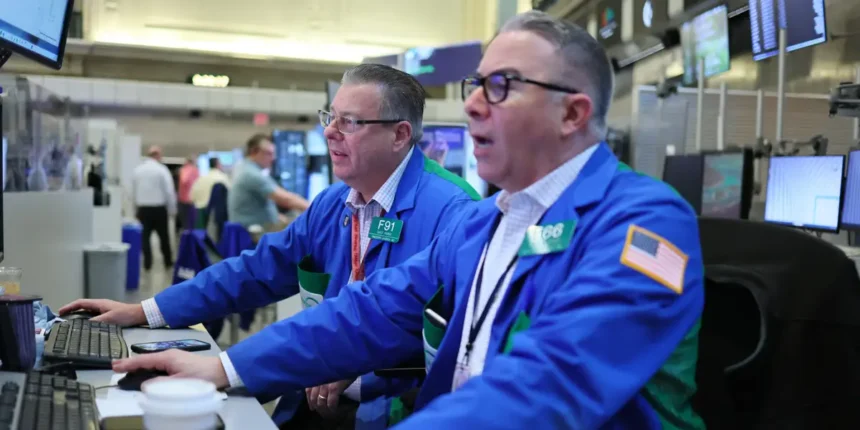
On Friday, the stock market experienced a notable surge following Iran’s announcement that the Strait of Hormuz had reopened for navigation. This development brought a wave of relief to investors who had been anxious about the repercussions of potentially prolonged disruptions to energy flows, which could have kept oil prices high and exacerbated inflationary pressures.
Market experts expressed optimism regarding the potential for economic revival, noting that a reduction in inflation risks could pave the way for the Federal Reserve to initiate interest rate cuts later this year. Charles Rinehart, chief investment officer at Johnson Investment Counsel, captured the sentiment, stating, “With the Strait of Hormuz now reopening, there’s renewed optimism that broader economic momentum can re-emerge.”
In light of this positive news, industry professionals were asked to identify the most promising investment opportunities should the reopening of the Strait maintain its positive impact.
Small-Caps
Mike Reynolds, VP of investment strategy at Glenmede, highlighted small-cap stocks as a strong buy. He noted several reasons for this bullish outlook: smaller companies tend to perform well in alignment with economic growth trends, and they are particularly sensitive to lower borrowing costs that could result from potential Federal Reserve rate cuts. In addition, the One Big Beautiful Bill Act, which allows immediate deductions for research and development costs, could provide a further boost. Reynolds projected that 2026 could be a standout year for small caps, recommending funds such as the Vanguard Small-Cap ETF (VB), the iShares Core S&P Small-Cap ETF (IJR), and the Dimensional US Small Cap ETF (DFAS).
Emerging Markets
When the Strait of Hormuz was closed earlier this year, emerging market stocks, particularly those in Asia, were significantly affected, given their economies’ reliance on Middle Eastern oil. With the Strait’s reopening, Stephen Parker, co-head of Global Investment Strategy at JPMorgan Private Bank, indicated that Asian emerging market stocks are set for recovery. He emphasized that despite recent sell-offs, the fundamentals within the tech sector—especially those linked to the AI trade in economies such as Korea, Taiwan, and China—remain strong and present a compelling investment opportunity. Recommended funds for this trade include the iShares MSCI Emerging Markets Asia ETF (EEMA) and the Schwab Emerging Markets Equity ETF (SCHE).
The Magnificent Seven
Lance Roberts, chief strategist at RIA Advisors, identified a prime opportunity in the so-called “Magnificent Seven” stocks: Nvidia, Meta, Microsoft, Amazon, Apple, Alphabet, and Tesla. He noted a significant decline in valuations for these mega-cap technology stocks, bringing them in line with the broader market for the first time since 2015. Given their robust earnings growth potential, Roberts recommended these stocks as a compelling buy at their current valuation levels. Investment options to gain exposure include the Roundhill Magnificent Seven ETF (MAGS) and the Vanguard Mega Cap Growth ETF (MGK).
As investors digest the implications of the Strait of Hormuz reopening, the sentiment among market professionals suggests a cautiously optimistic approach, with specific focus on small-cap stocks, emerging markets, and major technology players poised for growth.