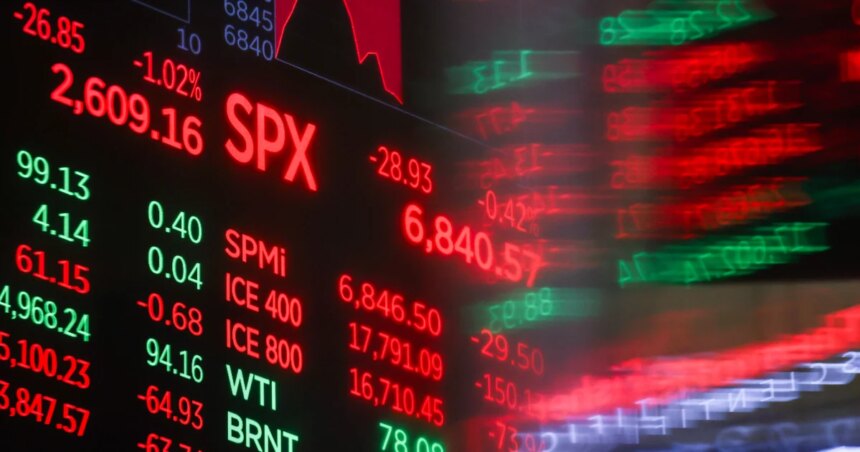
U.S. stocks experienced a downturn on Thursday, coinciding with a significant increase in oil prices, which continued to soar amid ongoing tensions in the Middle East. After a relatively stable trading day on Wednesday, the price of U.S. crude oil surged by more than 8% on Thursday, briefly hitting $82 per barrel. This marks a dramatic 20% increase since last Sunday, reaching its highest point since July 2024. The international oil benchmark also experienced a notable rise of 4%.
In contrast to the oil market, stock markets resumed a persistent sell-off that began earlier in the week. By the end of trading, the S&P 500 was down 0.6%, while the Nasdaq composite fell by 0.3%. The Dow Jones Industrial Average saw a more severe decline, plummeting over 1,000 points at one stage in the afternoon, before ultimately closing lower by 785 points or 1.6%. Energy stocks, however, stood out as the best-performing sector within the S&P 500, while sectors such as consumer staples, materials, and industrials faced substantial losses.
Accompanying these market shifts, retail gas prices have also risen sharply, with the nationwide average now sitting at $3.25 per gallon, an increase of more than 30 cents since Sunday, according to data from the price-tracking service GasBuddy. This rise in fuel prices is stoking fears of renewed inflation, leading to an uptick in Treasury yields. Late Thursday, the yield on the 10-year U.S. government bond surpassed 4.1%, while the 30-year yield exceeded 4.75%. As a direct consequence of these financial shifts, the average 30-year mortgage rate climbed to 6.13%.
This economic turbulence comes less than a week after the U.S. initiated military actions against Iran. Iranian Foreign Minister Abbas Araghchi expressed confidence in Iran’s ability to confront U.S. military actions, stating that the nation is prepared to respond if an invasion were to occur.
In an attempt to mitigate the economic fallout from these military actions, President Donald Trump announced that he would direct the U.S. International Development Finance Corporation to provide political risk insurance and guarantees for the financial security of maritime trade, particularly energy supplies passing through the Gulf. Meanwhile, insurance brokers are reportedly in discussions with the administration in hopes of resuming ship traffic off the Iranian coastline, although hundreds of vessels remain stranded.
The Strait of Hormuz, a vital maritime route off Iran’s southern coast, facilitates the passage of approximately 20% of the world’s daily oil supply. Following the strikes by the U.S. and Israel on Iran, ship traffic through this crucial waterway has virtually halted, heightening fears of a potential global oil supply crisis. While Araghchi stated that Iran currently has “no intention” of closing the strait, he warned that the situation could change depending on the trajectory of the conflict, asserting that all scenarios would be considered.
Beyond oil, Qatar—ranked as the world’s second-largest exporter of liquefied natural gas—has suspended production due to the effective closure of the Strait of Hormuz and military assaults on QatarEnergy’s operational sites. Consequently, U.S. natural gas prices have risen approximately 4% since Sunday, but the effects are more pronounced in Europe, where prices have skyrocketed by more than 50%.