Asian financial markets showed a mixed response on Wednesday, reflecting investor caution amid ongoing tensions related to the U.S.-Iran conflict. This uncertainty was underscored by President Donald Trump’s decision to extend a ceasefire, which was initially set to expire.
In Japan, the benchmark Nikkei 225 index recorded a modest gain, rising 0.4% to close at 59,585.86. Conversely, Australia’s S&P/ASX 200 saw a decline of 1.2%, finishing at 8,843.60. South Korea’s Kospi index, however, managed to improve by 0.5%, reaching 6,417.93. On the other hand, Hong Kong’s Hang Seng index fell by 1.2%, ending the day at 26,180.51, while the Shanghai Composite made slight progress, increasing by 0.5% to 4,106.26.
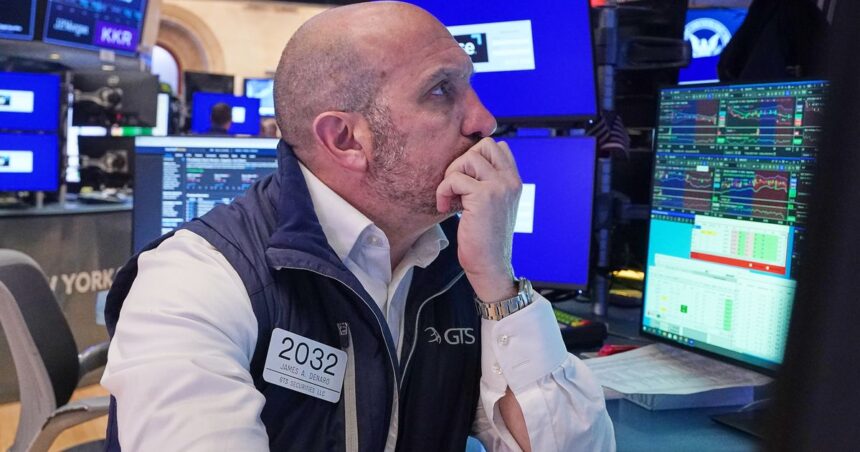
In the United States, the stock market experienced a downturn as the S&P 500 index reversed course, closing down 0.6% at 7,064.01 after initially starting the day on a positive note. The Dow Jones Industrial Average mirrored this trend, also decreasing by 0.6% to settle at 49,149.38, with the Nasdaq composite reflecting similar losses of 0.6%, closing at 24,259.96. This decline came shortly after U.S. Vice President JD Vance canceled a planned trip to Pakistan, where he was expected to engage in negotiations with Iran regarding the ceasefire.
Oil prices displayed volatility in Asian trading, with benchmark U.S. crude falling by 86 cents to $88.81 a barrel, while Brent crude, the international benchmark, dipped 68 cents to $97.80. This price action was muted compared to earlier fluctuations seen during the conflict, which had pushed Brent crude prices above $119 and prompted the S&P 500 to drop significantly.
Despite the recent decline, the U.S. stock market remains relatively stable, sitting close to its recent record high established last Friday. Investor sentiment appears cautiously optimistic that the ongoing negotiations between the U.S. and Iran may prevent a severe economic fallout.
The situation in the Strait of Hormuz, a crucial shipping lane for oil exports, continues to be a focal point for market observers. Japan, heavily reliant on imported oil, is particularly vulnerable, leading the government to stockpile reserves and consider alternative supply routes.
Analysts pointed out that Trump’s latest decision prolongs the existing uncertainty without delivering a clear resolution to the conflict. Tim Waterer, chief market analyst at KCM Trade, noted that while the extension of the ceasefire reduces immediate risks, the lack of a substantive agreement keeps traders hesitant.
In the bond market, the yield on the 10-year Treasury note increased to 4.31%, up from 4.26%, as oil prices fluctuated. Currency markets also saw movements, with the U.S. dollar slightly down against the Japanese yen at 159.15, compared to 159.38 previously, while the euro appreciated to $1.1751 from $1.1744.