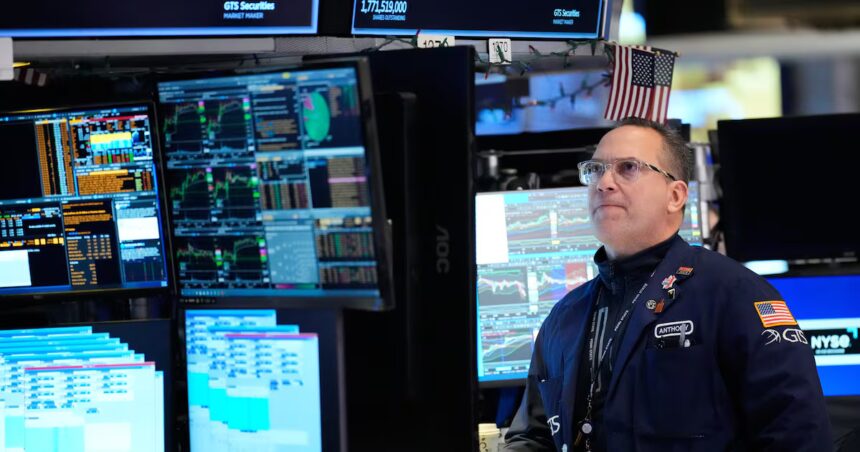
On Thursday, Wall Street experienced significant declines as rising oil prices drove market sentiment downward amid the ongoing conflict in Iran. The S&P 500 index fell by 0.6%, effectively erasing any small gains made earlier in the year. The Dow Jones Industrial Average suffered a brief plunge of over 1,100 points before closing down by 784 points, or 1.6%. The Nasdaq composite also slipped, posting a 0.3% decrease.
This downturn follows a dramatic spike in oil prices, which reached their highest levels since summer 2024. Benchmark U.S. crude posted an 8.5% increase, settling at $81.01 per barrel, while international benchmark Brent crude rose by 4.9% to $85.41 per barrel. These fluctuations have raised concerns about the potential for a prolonged increase in oil prices, prompting fears that it could negatively impact the global economy as household spending declines and interest rates climb.
The volatility in oil prices has already affected U.S. consumers, as gasoline prices surged to an average of $3.25 per gallon—up 9% from $2.98 just a week earlier. Analysts are voicing alarm that if crude reaches $100 per barrel and remains elevated, it could create insurmountable pressure on the global economy. The instability of the market has led to frenzied trading, with significant swings recorded on an hourly basis.
The situation’s future largely hinges on developments in the Strait of Hormuz, through which about 20% of the world’s oil trade typically passes. Despite the current turmoil, historical trends indicate that the U.S. stock market has often rebounded following conflicts in the Middle East, provided that oil prices do not maintain unsustainably high levels for extended periods.
Investors have been advised to remain patient, as many believe the market’s aversion to risk may only be temporary. Scott Wren, a senior global market strategist at Wells Fargo Investment Institute, noted that potential further escalation remains a risk, but the likely outcome would be a short-lived period of market caution until signs of hostilities easing become more apparent.
Despite the overall decline, the S&P 500 is only down 0.7% for the week, bolstered by gains in Big Tech stocks and increases in oil sector shares. Conversely, airline stocks faced some of the heaviest losses due to soaring fuel costs and service disruptions affecting hundreds of thousands of travelers in the Middle East. American Airlines dropped 5.4%, United Airlines fell by 5%, and Delta Air Lines sank 3.9%.
Additionally, smaller companies also took a hit, as investor fears about economic strength and rising interest rates weighed heavily. The Russell 2000 index of small-cap stocks fell by 1.9%. Wall Street’s declines could have been more pronounced without the influence of Broadcom, whose stock rose 4.8% following a strong earnings report highlighting a 74% increase in revenue from AI chips.
In final figures, the S&P 500 closed down 38.79 points at 6,830.71, while the Dow Jones Industrial Average fell 784.67 points to 47,954.74. The Nasdaq composite decreased by 58.50 points, finishing at 22,748.99.
In the bond market, Treasury yields inched higher, further pressured by rising oil prices and their potential inflationary impact. The yield on the 10-year Treasury rose to 4.13% from 4.09%, with figures prior to the Iran conflict sitting at 3.97%. The Federal Reserve’s anticipated interest rate cuts later this year may now be pushed back as traders adjust their forecasts in light of geopolitical tensions and economic uncertainties.
Overseas, Asian markets showed signs of recovery from a recent downturn, with South Korea’s Kospi climbing 9.6% after a historic drop. Conversely, European markets succumbed to the pressure of rising oil prices, with France’s CAC 40 decreasing by 1.5% and Germany’s DAX falling by 1.6%.