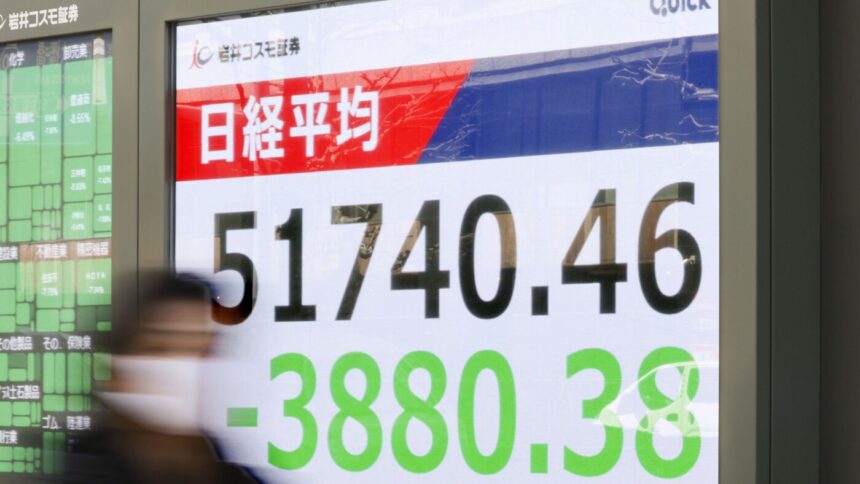
World shares faced significant declines on Monday, marking a rocky start to the week as Japan’s Nikkei 225 index plummeted by over 5%. This downturn was largely triggered by soaring oil prices, which approached $120 a barrel, causing alarm among economies reliant on oil and gas imports from the Middle East.
U.S. stock futures for the S&P 500, Nasdaq composite, and Dow Jones Industrial Average also reflected the gloomy sentiment, trading more than 1% lower after already dropping over 2% late on Sunday. The escalating situation in the Middle East prompted a call for action from Chinese special envoy Zhai Jun, who condemned attacks on civilian and non-military targets. Concurrently, South Korean President Lee Jae Myung urged against panic buying and price collusion among refiners and gas stations. He emphasized the need for a proactive response to the increasing financial and foreign exchange market volatility, announcing governmental measures to cap fuel prices.
The surge in oil prices followed weekend events where both warring sides targeted new installations, including civilian infrastructure. Bahrain attributed attacks on vital desalination plants to Iran, while its national oil company invoked force majeure after its only oil refinery was damaged. In turn, Israel conducted strikes on oil depots in Tehran, raising environmental concerns.
European markets did not fare any better, with early trading showing Germany’s DAX down 2.6% and France’s CAC 40 declining by 2.7%. The UK’s FTSE 100 also took a hit, dropping 1.9%. The sole exception to the trend was Norway, where its benchmark index edged slightly up by 0.1%.
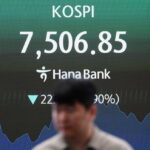
In Asia, Japan’s Nikkei 225 initially dropped over 7% but managed to recover slightly, closing 5.2% lower. South Korea’s Kospi fell 6%, while Chinese markets, typically less affected by global trends, saw more subdued declines. Hong Kong’s Hang Seng lost 1.4%, Shanghai Composite dropped 0.7%, and Taiwan’s benchmark index crashed 4.4%.
As of 0900 GMT, Brent crude was priced at $106.61 per barrel, with U.S. benchmark crude reaching $103.20, reflecting a 15% increase from Friday’s closing prices. The latest spike brought crude prices to their highest point in 14 years, amidst a war that has ensnared key regions critical for oil and gas operations.
Commentators expressed alarm over the ongoing situation. Stephen Innes of SPI Asset Management characterized the market’s reaction as an unwelcome wake-up call indicated by “the oil alarm bell,” underscoring the dire implications of escalating energy costs on global economies. High energy prices are anticipated to compound inflationary pressures and negatively impact growth, particularly as nations grapple with rising tariffs on exports to the U.S.
Officials from Southeast Asian countries convened for discussions in Manila, aiming to formulate strategies to mitigate the shock of rising energy costs. Meanwhile, analysts predicted that while oil prices might eventually stabilize, they are likely to remain elevated for an extended period, potentially revitalizing global inflation concerns.
In the U.S., a recent jobs report showing more job cuts than additions contributed to financial market unease. This economic backdrop, coupled with high inflation, presents a challenging scenario for investors, leaving the Federal Reserve with limited options for addressing both issues simultaneously.
On a different front, the U.S. dollar demonstrated resilience as a safe haven during these turbulent times, appreciating against other currencies. It was trading at 158.55 Japanese yen, while the euro slightly dipped to $1.1539 from $1.1556.