Asian stock markets experienced overall gains on Friday afternoon, reflecting stability in the U.S. stock market, which has remained close to record levels amidst low trading volumes. U.S. futures showed minor increases while oil prices experienced a slight downturn.
Japan’s Nikkei 225 index declined by 1.1%, settling at 50,491.87. This drop followed recent government data indicating that household spending in Japan fell 3.0% year-on-year in October, underperforming market expectations, which anticipated a modest increase. The decline signaled the most significant drop in spending since January 2024, impacting technology stocks in the region. Notably, Advantest Corp., a leading manufacturer of chip testing equipment, fell by 2.4%, while chip maker Tokyo Electron declined by 2%.
Traders remained cautious ahead of an important U.S. inflation report that analysts believe could affect Federal Reserve policy. On Thursday, reports suggested a stronger U.S. job market than anticipated, leading to a slight decrease in expectations for a Federal Reserve interest rate cut. This has amplified concerns regarding potential overinvestment in artificial intelligence and the Fed’s forthcoming decisions on interest rates.
In contrast, Chinese markets showed resilience, with Hong Kong’s Hang Seng index recovering from earlier losses, rising 0.6% to reach 26,085.08. The Shanghai Composite index also experienced an uptick, increasing nearly 0.7% to 3,902.81. However, traders were still cautious, awaiting key economic data next week from China regarding inflation, trade, and producer prices, as well as signals from crucial economic meetings in the country.
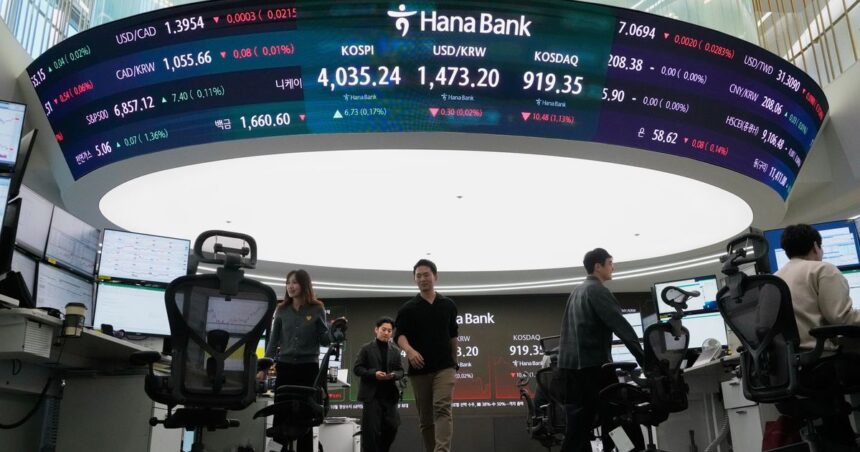
South Korea’s Kospi index saw a robust increase of 1.8%, climbing to 4,100.05, buoyed by significant gains in major corporations such as LG Electronics, which surged by 5.2%, and Hyundai Motors, which soared by 11.1%. Meanwhile, Australia’s S&P/ASX200 gained 0.2% to reach 8,634.60, and Taiwan’s Taiex added nearly 0.7%.
In India, the Sensex index advanced 0.5% following the Reserve Bank’s decision to cut its repo rate from 5.5% to 5.25% in response to subdued price pressures and anticipated slow economic growth.
Meanwhile, the U.S. stock market maintained a steady course as the S&P 500 inched up by 0.1%, closing at 6,857.12, only 0.5% short of its all-time high. The Dow Jones Industrial Average recorded a minor dip of 0.1%, settling at 47,850.94, while the Nasdaq composite rose by 0.2% to 23,505.14. Dollar General emerged as a significant market mover, surging by 14% after reporting stronger-than-expected quarterly profits, driven by an increase in customer traffic and improved profit margins.
Despite optimism about potential interest rate cuts to bolster a slowing U.S. job market, concerns about inflation remaining above the Fed’s 2% target loom large. Investors are generally in favor of lower interest rates, as they can enhance investment prices and stimulate economic activity, but they also raise inflation risks.
Recent data revealed encouraging indicators for the U.S. job market, indicating fewer unemployment claims and a notable reduction in layoffs, which fell by more than half from the previous month’s surge. This positive news could suggest that the job market may not require as much assistance through lower interest rates.
Additionally, as the trading day progressed, U.S. benchmark crude oil dropped by 12 cents to $59.55 per barrel, while Brent crude retreated 8 cents to $63.18 per barrel. The U.S. dollar experienced a decline, falling to 154.79 Japanese yen, down from 155.12 yen, while the euro strengthened to $1.1658 from $1.1645.